I know, I know. The neglect this blog suffers is bordering on criminal. I am pondering ways to remedy this, but in the meantime, here's a little snippet from the day job, albeit a few months old. In case you were wondering how I'm spending my time these days. Apologies, but this video can't be embedded, as far as I can work out.
Tuesday, April 28, 2015

Wednesday, January 22, 2014
Eye candy from Germany
Fresh from the hand of my friendly postman comes this beauty from my long-time friends and sometimes consulting clients, Seim & Partner, in beautiful Taunusstein. The team there spent quite a bit of time on this labour of love, with access to the underlying data of Greg's Cable Map, in an effort to create a thing of informative beauty, which is also both comprehensive *and* affordable. A copy will only set you back €49.90 plus VAT and postage. Order either via email (info@seim-partner.de) or via phone (+49 6128 609 22 69).
Tuesday, December 24, 2013
God bless us, every one!
Merry Christmas, dear reader. I hope the new year ahead holds untold wonders for you. I resolve, once again, to try to post more in 2014, as it marks the 10 year anniversary of this humble bloglet. In the meantime, here's hoping you enjoy the winter religious or secular observance of your choice.
One person has already received his Christmas present, and that's my friend and former colleague Tim McDonald, who is joining magicJack Vocaltec as COO! I first came into contact with Tim 10 years ago, as he was one of the early supporters of my blog. When I was invited to speak at an Eli Noam event at Columbia in late 2004, I got a chance to meet him face-to-face, and was introduced to some other members of his team at Merrill Lynch. Tim became a key advocate of my recruitment to that team, which I finally joined in 2007.
Tim possesses one of the sharpest minds I have encountered, and he is uber-connected in industry, as well as being a helluva nice fellow. I wish him every success in this new role, and I think the company is very fortunate to have him on board. I will follow developments with interest, as the world of VoIP is set to become more interesting in 2014.
One person has already received his Christmas present, and that's my friend and former colleague Tim McDonald, who is joining magicJack Vocaltec as COO! I first came into contact with Tim 10 years ago, as he was one of the early supporters of my blog. When I was invited to speak at an Eli Noam event at Columbia in late 2004, I got a chance to meet him face-to-face, and was introduced to some other members of his team at Merrill Lynch. Tim became a key advocate of my recruitment to that team, which I finally joined in 2007.
Tim possesses one of the sharpest minds I have encountered, and he is uber-connected in industry, as well as being a helluva nice fellow. I wish him every success in this new role, and I think the company is very fortunate to have him on board. I will follow developments with interest, as the world of VoIP is set to become more interesting in 2014.
Tuesday, December 10, 2013
My presentation last week in Budapest
Last week I had the pleasure of presenting at a conference hosted in beautiful Budapest by the Hungarian national telecom regulator, NMHH. The theme of the conference, broadly, was whether the telecom sector is once again becoming attractive to investors, and if not, why not and how might regulation play a role in restoring some stability to the sector? I was on a panel with three sell-side equity analysts, but I had determined beforehand to talk about the role of private entrepreneurial capital in changing the status quo in FTTx investment, with a particular focus on Germany and the UK. My presentation begins at 1:02:20.
The last few minutes of the video feature an unidentified commenter skewering my analysis of the UK market. He was speaking from the back of the room, and the lighting was such that I couldn't make out at the time who he was, but both the moderator and I came to the conclusion that he must be a BT employee, given the level of defensiveness and irritation evident in his commentary.
It turns out that it was Ed Richards of OFCOM. He lambastes me for the "utter nonsense" of suggesting that Spotify or Twitter require FTTH connections. That would be utter nonsense, if I'd actually said that, but I didn't. What I said was that if you live in a post-industrial city in Eastern Germany and you want to start the next Spotify or Twitter, you're going to need to move to Berlin (I was referencing a map which shows a dearth of connectivity >50Mbps outside of Berlin in the eastern half of the country).
Maybe I wasn't clear enough, but I was assuming the audience would implicitly understand the fact that start-ups dealing with data-intensive platforms need fast pipes to data centres, and these may not be readily available anywhere except the major cities. I never said, as Ed asserts, that Spotify or Twitter could never have been developed in the UK or Germany because of connectivity issues. My implication was that data-intensive start-ups would naturally gravitate to places where the connectivity and associated infrastructure was conducive, and that as long as this remains concentrated in a few large cities, it just perpetuates the economic disparity between the major hubs and the second tier cities struggling to redefine themselves. Perhaps years of listening to incumbents complaining about their imminent doom leads to a higher propensity towards selective deafness among the regulatory community.
I was also apparently too harsh for not recognising what has apparently been a highly successful and widespread UK fibre roll-out. I must have been asleep, because I haven't seen any fibre rolled out in the UK. Just because the ASA allows it to be marketed as "fibre optic broadband" doesn't magically make it fibre. On this basis, we might as well allow bog-standard ADSL to also be called fibre, as the exchanges where the DSLAMs sit are backhauled by fibre. Hell, mobile could be marketed as fibre. The term, as used in the Orwellian context in which it has been cast in the UK, is meaningless, though I fear that saying so might constitute thoughtcrime.
The last few minutes of the video feature an unidentified commenter skewering my analysis of the UK market. He was speaking from the back of the room, and the lighting was such that I couldn't make out at the time who he was, but both the moderator and I came to the conclusion that he must be a BT employee, given the level of defensiveness and irritation evident in his commentary.
It turns out that it was Ed Richards of OFCOM. He lambastes me for the "utter nonsense" of suggesting that Spotify or Twitter require FTTH connections. That would be utter nonsense, if I'd actually said that, but I didn't. What I said was that if you live in a post-industrial city in Eastern Germany and you want to start the next Spotify or Twitter, you're going to need to move to Berlin (I was referencing a map which shows a dearth of connectivity >50Mbps outside of Berlin in the eastern half of the country).
Maybe I wasn't clear enough, but I was assuming the audience would implicitly understand the fact that start-ups dealing with data-intensive platforms need fast pipes to data centres, and these may not be readily available anywhere except the major cities. I never said, as Ed asserts, that Spotify or Twitter could never have been developed in the UK or Germany because of connectivity issues. My implication was that data-intensive start-ups would naturally gravitate to places where the connectivity and associated infrastructure was conducive, and that as long as this remains concentrated in a few large cities, it just perpetuates the economic disparity between the major hubs and the second tier cities struggling to redefine themselves. Perhaps years of listening to incumbents complaining about their imminent doom leads to a higher propensity towards selective deafness among the regulatory community.
I was also apparently too harsh for not recognising what has apparently been a highly successful and widespread UK fibre roll-out. I must have been asleep, because I haven't seen any fibre rolled out in the UK. Just because the ASA allows it to be marketed as "fibre optic broadband" doesn't magically make it fibre. On this basis, we might as well allow bog-standard ADSL to also be called fibre, as the exchanges where the DSLAMs sit are backhauled by fibre. Hell, mobile could be marketed as fibre. The term, as used in the Orwellian context in which it has been cast in the UK, is meaningless, though I fear that saying so might constitute thoughtcrime.
Monday, September 16, 2013
Much money wasted, you have
I know Vodafone's got too much cash these days, but I think they missed a trick here. I can't count the number of times per day that I have to dodge inattentive people on the streets, due to the distraction of naughty texts, Facebook selfies, or YouTube videos of cats playing piano, and I wonder how many unnecessary injuries and physical altercations occur as a result of this sort of scenario. Beer companies don't glorify their product by showing humourous scenes of drunk drivers killing people irresponsibly, so why should Yoda step in to salvage an antisocial hipster behaving stupidly with a Vodafone device? The company could have saved itself some considerable expense by just letting the kid on the scooter head-butt him in the genitals at full speed. I would respect that. Might even tempt me to join Vodafone. Out of contract, I am.
Saturday, September 07, 2013
Misadventures in asset management
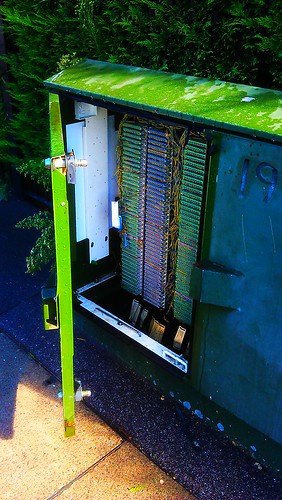
This is a BT street cabinet on Townley Road, East Dulwich. It's been open at least five days. Luckily, it appears that the copper thieves we hear so much about haven't ravaged it yet. It's on a stretch of pavement that sees a lot of traffic from school kids, so it's sort of surprising that a curious child, or one with vandalous tendencies, hasn't yanked out a fistful of phone lines. There's a VDSL cabinet a few metres away, so I'm guessing the engineer did some provisioning and forgot to lock up.
Makes me wonder why the M2M brigade haven't created a simple GSM-enabled device with a light meter, which could report hourly. Three consecutive hourly reports of ambient light above a certain threshold could generate a flag to alert the asset management team that the cabinet is most likely open, and a truck roll could be organised.
Another approach could be crowdsourcing. Find two or three dependable people in each urban postcode to walk a designated route covering a number of cabinets every day or so, and report problems, in exchange for free service. Like a kind of broadband neighbourhood watch.
Or just set up a Twitter account, like @OpenBTcabinets.
That is, if anyone cares...
Wednesday, September 04, 2013
Adventures in Cambodian overhead cabling
Apologies, vestigial mega-uber value readers, for my ongoing lack of output. As usual, I'm involved in some very interesting stuff, which I can't really talk about. What I can share is that I've been doing some consultancy work with a company in Cambodia, and I've observed and photographed the most surreal cabling "solutions" I've ever seen. I wish I'd taken more photos to share with you, but after a couple of days there, the massive snarls of (mostly) fiber overhead become a commonplace sight, and my eye is drawn to all the other amazing sights in this fascinating place.
If you look closely at some of these photos, you'll see PON splitter enclosures, which almost certainly serve customers of one of Phnom Penh's FTTH operators. Yes, you heard me right, FTTH in Phnom Penh, capital of a country where many people earn less than $100 per month. It's a niche product, however, targeted at affluent locals and the burgeoning ex-pat community. How do you fancy paying $225 per month for 4Mbps? Not a power user? How about $115 for 2Mbps? Granted, IP transit is expensive in Cambodia, because of the absence of an undersea cable landing (though that's going to change, and it will be interesting to see how pricing/demand moves in the aftermath), but I think we can guess what the margins must be on these products with pricing like that. This is an interesting conundrum, wherein a superior technology is throttled back to keep opex low, and also to avoid taking the market beyond where it is "ready" to go. I don't mean that Cambodians wouldn't love 1Gbps connections today, but if 512k/1Mbps is the current benchmark, then I assume the commercial guys would question why an operator should force things to evolve dramatically faster than the market really demands?
If you look closely at some of these photos, you'll see PON splitter enclosures, which almost certainly serve customers of one of Phnom Penh's FTTH operators. Yes, you heard me right, FTTH in Phnom Penh, capital of a country where many people earn less than $100 per month. It's a niche product, however, targeted at affluent locals and the burgeoning ex-pat community. How do you fancy paying $225 per month for 4Mbps? Not a power user? How about $115 for 2Mbps? Granted, IP transit is expensive in Cambodia, because of the absence of an undersea cable landing (though that's going to change, and it will be interesting to see how pricing/demand moves in the aftermath), but I think we can guess what the margins must be on these products with pricing like that. This is an interesting conundrum, wherein a superior technology is throttled back to keep opex low, and also to avoid taking the market beyond where it is "ready" to go. I don't mean that Cambodians wouldn't love 1Gbps connections today, but if 512k/1Mbps is the current benchmark, then I assume the commercial guys would question why an operator should force things to evolve dramatically faster than the market really demands?
Wednesday, April 10, 2013
If you've got it, flaunt it
Never fear, mega-uber value readers. It's not another lengthy diatribe, just a quick observation.
Yesterday, while working at home on a project for a client, I must have been feeling a bit masochistic, because I decided to switch on Bloomberg Television, to catch up on the news in the financial markets. Once upon a time, my team at Merrill Lynch used to have it on all day, every day, and I guess it makes me feel a bit nostalgic.
Anyway, among the numerous commercials for online training courses to help you "trade like a pro" and forex trading platforms offering individual investors 5:1 leverage on margin (is it still 1999?), I happened to take notice of a commercial from the InvestBulgaria Agency. The pitch was built around reasons someone might want to locate a business in the country. There were all the usual suspects: low corporate tax rate, low labour costs, young workforce with a lot of people speaking a second language, etc.
However, tacked on the end of the list of positives was, "Bulgaria enjoys the eighth fastest internet speeds in the world." Presumably the country is using the Akamai rankings, and while I know there are many out there who would argue that national average peak speeds are potentially a red herring when deciding on where specifically to locate a business, it's still interesting to me. While the InvestBulgaria website's pitch omits a reference to broadband in favour of more detailed economic and financial arguments, I think it's telling that the short TV spot would play the broadband card, if only at the end.
Connectivity may be a marginal factor for many businesses in the grand scheme of things, but for a growing number, I believe it will be their lifeblood, if it isn't already. Any country seeking to attract business formation would only be wise to tout the superior nature of its broadband infrastructure - well, that is, if it actually has anything to talk about.
Yesterday, while working at home on a project for a client, I must have been feeling a bit masochistic, because I decided to switch on Bloomberg Television, to catch up on the news in the financial markets. Once upon a time, my team at Merrill Lynch used to have it on all day, every day, and I guess it makes me feel a bit nostalgic.
Anyway, among the numerous commercials for online training courses to help you "trade like a pro" and forex trading platforms offering individual investors 5:1 leverage on margin (is it still 1999?), I happened to take notice of a commercial from the InvestBulgaria Agency. The pitch was built around reasons someone might want to locate a business in the country. There were all the usual suspects: low corporate tax rate, low labour costs, young workforce with a lot of people speaking a second language, etc.
However, tacked on the end of the list of positives was, "Bulgaria enjoys the eighth fastest internet speeds in the world." Presumably the country is using the Akamai rankings, and while I know there are many out there who would argue that national average peak speeds are potentially a red herring when deciding on where specifically to locate a business, it's still interesting to me. While the InvestBulgaria website's pitch omits a reference to broadband in favour of more detailed economic and financial arguments, I think it's telling that the short TV spot would play the broadband card, if only at the end.
Connectivity may be a marginal factor for many businesses in the grand scheme of things, but for a growing number, I believe it will be their lifeblood, if it isn't already. Any country seeking to attract business formation would only be wise to tout the superior nature of its broadband infrastructure - well, that is, if it actually has anything to talk about.
Monday, April 01, 2013
Less diagnosis, more cure
My previous post could easily be criticised as an example of diagnosis without any proposed remedy, the eternal curse of the analyst and self-proclaimed pundit. However, it was really intended as a starting point, from which some proposals could be explored. So here's my first.
As I was looking through BT's shareholder register (as sourced from Bloomberg) in researching the previous piece, a few names popped up which intrigued me, so I scoured the list to find all similar entities (at least those which could be identified - no doubt there are others in nominee accounts or funds which are not visible to me). These were local government authorities and similar organs of government. Whether or not the holdings are all still current is unclear, but, if Bloomberg's data is correct, then at some point over the past 15 months or so, a rather long list of local/regional governmental entities (Isle of Wight County Council, Corporation of London, London Borough of Hammersmith & Fulham, London Borough of Lambeth, Falkirk CC, Carmarthenshire (Dyfed) CC, Surrey CC, Staffordshire CC, Nottinghamshire CC, Somerset CC, North Yorkshire CC, Warwickshire CC, Kent CC, Shropshire CC, City of Westminster, Northamptonshire CC, Hertfordshire CC, Hampshire CC, Cambridgeshire CC, City of Edinburgh, Middlesborough CC, Derbyshire CC, South Yorkshire Pensions Authority, Lancashire CC, East Riding of Yorkshire, and West Yorkshire Pension Fund) held, between them, 95.28m BT shares. At today's share price, that represents a value of £265m.
Invariably, these are held as part of pension schemes, with the fund managers in charge selecting BT for its relatively defensive characteristics and dividend yield. All perfectly natural.
However, I can't count the times I have heard economic development people from councils all over the UK complaining about poor connectivity, and the need to pursue another solution in order to differentiate their town/city/county, to attract and retain business, and to improve the quality of life for their residents. Again, there is an uncomfortable disconnect here, between the local authority pension, which parks part of its fund in BT shares in order to preserve and grow value for its beneficiaries with low risk, and the necessarily more forward-looking council members and civil servants, who are trying to deal with the uncertainties of the future stemming from economic downturn and austerity. In some cases, their efforts might necessitate a path which avoids BT entirely, in conflict with the interests of BT shareholders, e.g., the pension fund.
So, where would a forward-looking local authority with a bit of capital to invest (I know this in itself is a contentious assumption in the current climate) turn to reap the long-term benefits of the wave of investment in true fibre access which the country requires to keep pace with other economies in Europe and Asia?
At the moment, nowhere. The handful of small companies out there actually trying to change the status quo are all privately funded, and it's difficult to envisage a conservative pension fund, particularly from the public sector, making a direct investment in such vehicles.
However, what about a fibre infrastructure fund, seeded by private sector insurance/pension funds or a large family office, managed by an independent team of industry experts, in cooperation with delivery partners and a consortium of service providers, which could deliver long-term stable dividend streams, and even the potential of a liquidity event via public listing at some later date? It could be a single national fund, or several regional funds, as best aligns the investors and recipient projects.
This is not a new idea, particularly. What I have in mind is not dissimilar at all from what the great team at Broadway Partners are working on, though my version would be more skewed to larger concentrations of population, and with institutional backing, though I see no reason that an EIS scheme couldn't be part of the mix.
If such an entity existed, with strong enough backing from credible institutional seed investors and service providers, I believe it would be a perfect place for local authority pension schemes to allocate at least some of the funds which they have historically parked in BT. And, as a private fund, the projects undertaken by the entity could sidestep the shit-storm that always accompanies anything with a whiff of state aid about it. Thus, the local authorities could directly invest in a vehicle with the single, explicit aim of providing true fibre connectivity in the UK, which might even directly benefit the investing authorities, if they ended up being selected for development by the independent fund management team. At the very least, I believe they would receive handsome and stable financial returns over the long term.
As is always the case when fibre is involved, I know there are many out there who will argue that this is an impractical solution, with myriad reasons why it would not work. I believe, not only that it could easily work, but that we will see precisely this model emerge elsewhere. As with fibre itself, the main question then will be how far behind the curve the UK is willing to remain.
As I was looking through BT's shareholder register (as sourced from Bloomberg) in researching the previous piece, a few names popped up which intrigued me, so I scoured the list to find all similar entities (at least those which could be identified - no doubt there are others in nominee accounts or funds which are not visible to me). These were local government authorities and similar organs of government. Whether or not the holdings are all still current is unclear, but, if Bloomberg's data is correct, then at some point over the past 15 months or so, a rather long list of local/regional governmental entities (Isle of Wight County Council, Corporation of London, London Borough of Hammersmith & Fulham, London Borough of Lambeth, Falkirk CC, Carmarthenshire (Dyfed) CC, Surrey CC, Staffordshire CC, Nottinghamshire CC, Somerset CC, North Yorkshire CC, Warwickshire CC, Kent CC, Shropshire CC, City of Westminster, Northamptonshire CC, Hertfordshire CC, Hampshire CC, Cambridgeshire CC, City of Edinburgh, Middlesborough CC, Derbyshire CC, South Yorkshire Pensions Authority, Lancashire CC, East Riding of Yorkshire, and West Yorkshire Pension Fund) held, between them, 95.28m BT shares. At today's share price, that represents a value of £265m.
Invariably, these are held as part of pension schemes, with the fund managers in charge selecting BT for its relatively defensive characteristics and dividend yield. All perfectly natural.
However, I can't count the times I have heard economic development people from councils all over the UK complaining about poor connectivity, and the need to pursue another solution in order to differentiate their town/city/county, to attract and retain business, and to improve the quality of life for their residents. Again, there is an uncomfortable disconnect here, between the local authority pension, which parks part of its fund in BT shares in order to preserve and grow value for its beneficiaries with low risk, and the necessarily more forward-looking council members and civil servants, who are trying to deal with the uncertainties of the future stemming from economic downturn and austerity. In some cases, their efforts might necessitate a path which avoids BT entirely, in conflict with the interests of BT shareholders, e.g., the pension fund.
So, where would a forward-looking local authority with a bit of capital to invest (I know this in itself is a contentious assumption in the current climate) turn to reap the long-term benefits of the wave of investment in true fibre access which the country requires to keep pace with other economies in Europe and Asia?
At the moment, nowhere. The handful of small companies out there actually trying to change the status quo are all privately funded, and it's difficult to envisage a conservative pension fund, particularly from the public sector, making a direct investment in such vehicles.
However, what about a fibre infrastructure fund, seeded by private sector insurance/pension funds or a large family office, managed by an independent team of industry experts, in cooperation with delivery partners and a consortium of service providers, which could deliver long-term stable dividend streams, and even the potential of a liquidity event via public listing at some later date? It could be a single national fund, or several regional funds, as best aligns the investors and recipient projects.
This is not a new idea, particularly. What I have in mind is not dissimilar at all from what the great team at Broadway Partners are working on, though my version would be more skewed to larger concentrations of population, and with institutional backing, though I see no reason that an EIS scheme couldn't be part of the mix.
If such an entity existed, with strong enough backing from credible institutional seed investors and service providers, I believe it would be a perfect place for local authority pension schemes to allocate at least some of the funds which they have historically parked in BT. And, as a private fund, the projects undertaken by the entity could sidestep the shit-storm that always accompanies anything with a whiff of state aid about it. Thus, the local authorities could directly invest in a vehicle with the single, explicit aim of providing true fibre connectivity in the UK, which might even directly benefit the investing authorities, if they ended up being selected for development by the independent fund management team. At the very least, I believe they would receive handsome and stable financial returns over the long term.
As is always the case when fibre is involved, I know there are many out there who will argue that this is an impractical solution, with myriad reasons why it would not work. I believe, not only that it could easily work, but that we will see precisely this model emerge elsewhere. As with fibre itself, the main question then will be how far behind the curve the UK is willing to remain.
Thursday, March 14, 2013
Misalignment
One of the greatest sources of disappointment in life is our own unrealistic expectations. If you found yourself stuck at sea on a lifeboat with a tiger, you wouldn't expect it to suddenly adopt a vegan lifestyle just because doing so would save your ass. You wouldn't expect a bureaucrat to ever advocate less red tape. Turkeys don't vote for Christmas, and incumbent telco shareholders don't advocate cannibalising the assets they generously received through privatisation - assets which, through their eyes, have decades of life still left in them. People and institutions (which are made of people, well most of them anyway, with the possible exception of Goldman Sachs) will almost never give you what you want, apart from occasions when their self-interest coincides with yours.
But some people never learn. You can't swing a dead router these days without hitting someone who thinks it's down to the government to solve the broadband problem. Without wanting to make this an overtly political post, does anyone really believe the government is best-placed to do that, when it seems to struggle to optimize the things it already does? I guess there could be a financial incentive, in the form of taxing under-utilized bandwidth on "ultrafast" broadband connections, but I hate to think of the implementation schedule. Whereas Singapore, Australia and New Zealand have all taken radical approaches to stimulating fibre deployment, the UK government's approach has been incrementalist, and based on its recent form in providing public funding for NGA, I'm not hugely encouraged, to say the least, though I would stop short of saying that the entire venture has failed to stimulate the economy - a not inconsiderable number of lawyers and consultants will no doubt be paying someone to dig swimming pools at their second homes this spring. Every little helps.
So, inevitably, the focus of everyone's ire turns to BT. A few weeks back, at the FTTH Council Europe event in London, one panel I attended contained a great sound bite from a BT apparatchik, which was, "We think that if the really compelling applications which require fibre are still 10 years away, then we should wait until then to build the networks." He said this with a straight face, but his was the only one in the room, apart from his public affairs colleague, who seemed to quietly spit blood any time anyone else on the panel spoke.
Waiting 10 years to start building networks which take 10 years to build means that we get the "networks of tomorrow" 10 years later than they are required. Okay, you and I know it's silly, and he probably knows it's silly too, but everyone's got to feed their kids, and we all end up spouting someone else's dogma at some point, gritting our teeth as we think about paying off credit cards, taking the family away somewhere nice, or building a loft extension.
Then again, it's not silly at all, in light of my opening paragraph. I'll spare you a repeat of all the constraints on BT from a balance sheet perspective, but they are material, and the company has to manage the complex demands of shareholders, lenders, customers, and the regulator. Moreover, from its own perspective, and those of its shareholders, it would be cannibalising existing assets and crushing its own cash flows if it were much more aggressive in deploying true FTTP (how it could possibly be less aggressive, is an imponderable question).
To borrow Mr. Livingston's analogy from several years back, would Ford shareholders back a £20bn investment program to upgrade all its plants to produce Ferraris, when people are still buying Fords? Probably not, unless north of 30% of the market started buying Ferraris instead of Fords, however, that would require someone to sell Ferraris in volume, and at the moment, there is no one on the UK broadband scene able to pose that sort of threat, yet. As a result, viewed through the lens of BT, why fix it if it ain't broke?
But surely the "B" stands for British, and good old BT genuinely cares about the long-term competitiveness of UK plc, right? I'm sure that's true (apart from competitiveness as in "competition in infrastructure"), and in my experience the company never misses a chance at NextGen Roadshows to trumpet its contribution to regional and national employment (which I've always read more as a veiled threat to government, but I'm probably just paranoid). And surely its shareholders, in investing in a British company, are implicitly backing UK plc, right? After all, a stronger and more innovative economy in the UK ultimately means better demand for BT products, and greater spending capacity on the part of customers. So, BT shareholders should surely be aligned with the national agenda there, right?
Well, actually, probably not.
My friend Benoit (who very kindly posted something nice on my return), recently pointed to an interesting article by our friend Stefan, who has derived an average holding period of less than one year for investors in incumbent telcos. This underlines his view (which I have shared for many years) that the investor base of these companies is fundamentally unsuited to backing long-term transformational investment programs such as FTTH.
For those unaccustomed to the investment banking or asset management worlds, I would stress that this is nothing unique to telecoms, by any means. Traditional "long-only" fund managers are routinely (monthly, quarterly, annually, as befits their firms' policies) appraised on the basis of their performance relative to a defined benchmark, for example the MSCI or the STOXX. Whatever the relevant benchmark, the fund manager and his team will have a stance on which sectors they are more or less confident about, and this is reflected in the weightings of sectors within the portfolio, which are constantly reappraised and tweaked.
For example, if telecoms accounted for 10% of the total European market by capitalisation, and the fund manager were confident of the sector's prospective performance, he might put 11 - 15% of his portfolio into the sector (otherwise known as an "overweight" position), at the expense of some other sector. Conversely, a pessimistic view might take him "underweight" by the same sort of margin. It is extremely unusual, in my experience, for a traditional fund to have a "zero weighting" in a particular sector, apart from perhaps short periods surrounding cataclysmic market disruptions, such as 9/11 or the Lehman collapse.
The risk of being seriously underweight, or zero-weight, in a given sector is that, obviously, if something unforeseen or technically-driven occurs, it can be very damaging to performance - for example, the technical dislocations of the market in the immediate wake of 9/11 drove investors out of airlines and insurance companies, and into telecom, providing a brief and dramatic reversal of fortunes in a sector which had been bottom-of-the-barrel consistently for over a year. Anyone seriously underweight telecom at that point would have been racing to catch the pack.
In any event, given that most traditional funds can only deal with the market in such a fairly conservative fashion at the sector level, the secret to success thus lies in stock selection. Even here, there are technical factors at work - the likes of Vodafone and Telefonica have traditionally been such large constituents of the sector, that most funds would own one or both as core holdings, and then selectively augment their portfolio with some smaller names.
All the constituent telecom stocks of the portfolio are typically subject to regular adjustments in size. Positions in stocks which have done well, but are now pushing the envelope on valuation grounds, might be pared back in favour of those which have lagged. For some smaller holdings, it isn't at all uncommon for the fund manager to switch completely out of one name (Telenor, for example) and into another (KPN, for example), subject to his criteria around valuation, macro environment, technical indicators, or adverse developments in corporate strategy or policy.
Typically, any corporate policy likely to threaten dividend income for the investor, or to risk seriously constraining company cash flow in the short term will be punished by shareholder flight. For example, a major capex program - for a graphic reminder, look back at Verizon's torrid share price performance post its commitment to FiOS. No matter that Verizon's decision would appear to be, by most accounts, resoundingly vindicated as we look back at it today. At the time, people freaked out.
This is, sadly, just the nature of institutional asset management, which is a highly competitive industry in its own right, forever measuring its performance over the last quarter against peers and rivals. If you want aggressive, bold, long-term directional commitment to sometimes unconventional strategies, invest in Berkshire Hathaway, because the mainstream industry is considerably more fickle and short-termist. That's what it has to be in order to remain what it is, so to speak.
And just like BT, the pension fund or insurance company fund manager has a duty to maximise returns and minimise downside risks for his investors and beneficiaries, even if they live in the UK and would benefit in the long term from an improved macroeconomic environment enhanced by fibre. If BT made an aggressive plunge into FTTP, which saw the share price crater and dividends reduced, trust me, Mr. UK Fund Manager would soon find better value in a Hungarian cable company, and he'd be gone with the wind, only to return once the model had either been proven, or abandoned.
Which, to Stefan's point, is precisely why Mr. UK Fund Manager is not the right source of long-term, patient money with which to fund the huge investment required for FTTH, at least not via incumbents, because funds invest in incumbents for cash flow and stability, on the whole, not as long-tail investments which burn a lot of cash in the early years. The very investment thesis is thus completely inconsistent and unpalatable for both the investor and the incumbent, so there's no logical reason for either to go there, in terms of the ways they view the world.
On top of this fundamental problem in the market, I see one other source of misalignment, and that is the national domicile of some of the institutions which invest in incumbents. A colleague once told me that this was a red herring, and I'm not trying to go "all nationalistic and shit," but it is a fact that the age of globalization means that there is no longer a clear correlation between the home market of a telco and its shareholder base, which I believe reduces the level of alignment between the national economic agenda and the behaviour of the incumbent in making new investments.
For example, going back to the "B" in BT, a good friend and former colleague still in the financial markets pulled down the shareholder register for BT (as compiled by Bloomberg) a couple of days ago, as a favour to me. Given that it's a list compiled by a third party, it may not be considered authoritative, but it certainly makes interesting reading. If the data is correct, then of the 63 institutional shareholdings identified as being 0.5% of the company or more, 23 are held by funds classified as being non-British. However, the non-British positions are more concentrated, with six of the top ten holdings being non-British, and the aggregate of all holdings above 0.5% shows a split of 42% of the company in non-British funds, and 49% in British funds.
So, to recap, not only is Mr. UK Fund Manager not likely to back a bold digression from the current strategy in the interest of helping transform the country, but something like half the company is in the hands of people who have no skin in the game at all. That sounds harsh, but let's be realistic - what real interest does a Dutch public sector pension fund, the Norwegian sovereign wealth fund, or the People's Republic of China really have in seeing an improvement in the competitiveness of the British economy, let alone future-proof connectivity for Coventry, Newport or Falkirk?
I use the names of relatively obscure British towns by design, because these are the sorts of places that feel the greatest need for fibre, as a differentiator which aids new business formation, business retention, and improves the quality of life for residents. However, institutional investors don't see things down to this level, not even within the UK, let alone outside it. It's not what they do. It's not what they're paid to do. Telco shares are assets in a thoroughly globalized game of Monopoly, where, when one tires of Fleet Street, it's easily sold, and Picadilly is bought. The fact that real people's lives and livelihoods, and the future of the economy, may hang in the balance, doesn't enter into it. Thus the national telco is, in the eyes of the shareholders who drive it, abstracted from the future of the economy it serves, despite having potentially such a huge influence on what that future looks like. It's a strange state of affairs, but not at all uncommon, and it's just the way the world works today.
So, where does all this leave us? Well, when it comes to FTTH, to paraphrase David Cameron, we're all in this together. All of us, that is, apart from the government, institutional investors in BT, and BT itself, none of which are remotely aligned to an agenda which says that the country needs ubiquitous fibre provided by the incumbent. Therefore, I think we should all stop expecting any of them to form any meaningful part of the solution.
But some people never learn. You can't swing a dead router these days without hitting someone who thinks it's down to the government to solve the broadband problem. Without wanting to make this an overtly political post, does anyone really believe the government is best-placed to do that, when it seems to struggle to optimize the things it already does? I guess there could be a financial incentive, in the form of taxing under-utilized bandwidth on "ultrafast" broadband connections, but I hate to think of the implementation schedule. Whereas Singapore, Australia and New Zealand have all taken radical approaches to stimulating fibre deployment, the UK government's approach has been incrementalist, and based on its recent form in providing public funding for NGA, I'm not hugely encouraged, to say the least, though I would stop short of saying that the entire venture has failed to stimulate the economy - a not inconsiderable number of lawyers and consultants will no doubt be paying someone to dig swimming pools at their second homes this spring. Every little helps.
So, inevitably, the focus of everyone's ire turns to BT. A few weeks back, at the FTTH Council Europe event in London, one panel I attended contained a great sound bite from a BT apparatchik, which was, "We think that if the really compelling applications which require fibre are still 10 years away, then we should wait until then to build the networks." He said this with a straight face, but his was the only one in the room, apart from his public affairs colleague, who seemed to quietly spit blood any time anyone else on the panel spoke.
Waiting 10 years to start building networks which take 10 years to build means that we get the "networks of tomorrow" 10 years later than they are required. Okay, you and I know it's silly, and he probably knows it's silly too, but everyone's got to feed their kids, and we all end up spouting someone else's dogma at some point, gritting our teeth as we think about paying off credit cards, taking the family away somewhere nice, or building a loft extension.
Then again, it's not silly at all, in light of my opening paragraph. I'll spare you a repeat of all the constraints on BT from a balance sheet perspective, but they are material, and the company has to manage the complex demands of shareholders, lenders, customers, and the regulator. Moreover, from its own perspective, and those of its shareholders, it would be cannibalising existing assets and crushing its own cash flows if it were much more aggressive in deploying true FTTP (how it could possibly be less aggressive, is an imponderable question).
To borrow Mr. Livingston's analogy from several years back, would Ford shareholders back a £20bn investment program to upgrade all its plants to produce Ferraris, when people are still buying Fords? Probably not, unless north of 30% of the market started buying Ferraris instead of Fords, however, that would require someone to sell Ferraris in volume, and at the moment, there is no one on the UK broadband scene able to pose that sort of threat, yet. As a result, viewed through the lens of BT, why fix it if it ain't broke?
But surely the "B" stands for British, and good old BT genuinely cares about the long-term competitiveness of UK plc, right? I'm sure that's true (apart from competitiveness as in "competition in infrastructure"), and in my experience the company never misses a chance at NextGen Roadshows to trumpet its contribution to regional and national employment (which I've always read more as a veiled threat to government, but I'm probably just paranoid). And surely its shareholders, in investing in a British company, are implicitly backing UK plc, right? After all, a stronger and more innovative economy in the UK ultimately means better demand for BT products, and greater spending capacity on the part of customers. So, BT shareholders should surely be aligned with the national agenda there, right?
Well, actually, probably not.
My friend Benoit (who very kindly posted something nice on my return), recently pointed to an interesting article by our friend Stefan, who has derived an average holding period of less than one year for investors in incumbent telcos. This underlines his view (which I have shared for many years) that the investor base of these companies is fundamentally unsuited to backing long-term transformational investment programs such as FTTH.
For those unaccustomed to the investment banking or asset management worlds, I would stress that this is nothing unique to telecoms, by any means. Traditional "long-only" fund managers are routinely (monthly, quarterly, annually, as befits their firms' policies) appraised on the basis of their performance relative to a defined benchmark, for example the MSCI or the STOXX. Whatever the relevant benchmark, the fund manager and his team will have a stance on which sectors they are more or less confident about, and this is reflected in the weightings of sectors within the portfolio, which are constantly reappraised and tweaked.
For example, if telecoms accounted for 10% of the total European market by capitalisation, and the fund manager were confident of the sector's prospective performance, he might put 11 - 15% of his portfolio into the sector (otherwise known as an "overweight" position), at the expense of some other sector. Conversely, a pessimistic view might take him "underweight" by the same sort of margin. It is extremely unusual, in my experience, for a traditional fund to have a "zero weighting" in a particular sector, apart from perhaps short periods surrounding cataclysmic market disruptions, such as 9/11 or the Lehman collapse.
The risk of being seriously underweight, or zero-weight, in a given sector is that, obviously, if something unforeseen or technically-driven occurs, it can be very damaging to performance - for example, the technical dislocations of the market in the immediate wake of 9/11 drove investors out of airlines and insurance companies, and into telecom, providing a brief and dramatic reversal of fortunes in a sector which had been bottom-of-the-barrel consistently for over a year. Anyone seriously underweight telecom at that point would have been racing to catch the pack.
In any event, given that most traditional funds can only deal with the market in such a fairly conservative fashion at the sector level, the secret to success thus lies in stock selection. Even here, there are technical factors at work - the likes of Vodafone and Telefonica have traditionally been such large constituents of the sector, that most funds would own one or both as core holdings, and then selectively augment their portfolio with some smaller names.
All the constituent telecom stocks of the portfolio are typically subject to regular adjustments in size. Positions in stocks which have done well, but are now pushing the envelope on valuation grounds, might be pared back in favour of those which have lagged. For some smaller holdings, it isn't at all uncommon for the fund manager to switch completely out of one name (Telenor, for example) and into another (KPN, for example), subject to his criteria around valuation, macro environment, technical indicators, or adverse developments in corporate strategy or policy.
Typically, any corporate policy likely to threaten dividend income for the investor, or to risk seriously constraining company cash flow in the short term will be punished by shareholder flight. For example, a major capex program - for a graphic reminder, look back at Verizon's torrid share price performance post its commitment to FiOS. No matter that Verizon's decision would appear to be, by most accounts, resoundingly vindicated as we look back at it today. At the time, people freaked out.
This is, sadly, just the nature of institutional asset management, which is a highly competitive industry in its own right, forever measuring its performance over the last quarter against peers and rivals. If you want aggressive, bold, long-term directional commitment to sometimes unconventional strategies, invest in Berkshire Hathaway, because the mainstream industry is considerably more fickle and short-termist. That's what it has to be in order to remain what it is, so to speak.
And just like BT, the pension fund or insurance company fund manager has a duty to maximise returns and minimise downside risks for his investors and beneficiaries, even if they live in the UK and would benefit in the long term from an improved macroeconomic environment enhanced by fibre. If BT made an aggressive plunge into FTTP, which saw the share price crater and dividends reduced, trust me, Mr. UK Fund Manager would soon find better value in a Hungarian cable company, and he'd be gone with the wind, only to return once the model had either been proven, or abandoned.
Which, to Stefan's point, is precisely why Mr. UK Fund Manager is not the right source of long-term, patient money with which to fund the huge investment required for FTTH, at least not via incumbents, because funds invest in incumbents for cash flow and stability, on the whole, not as long-tail investments which burn a lot of cash in the early years. The very investment thesis is thus completely inconsistent and unpalatable for both the investor and the incumbent, so there's no logical reason for either to go there, in terms of the ways they view the world.
On top of this fundamental problem in the market, I see one other source of misalignment, and that is the national domicile of some of the institutions which invest in incumbents. A colleague once told me that this was a red herring, and I'm not trying to go "all nationalistic and shit," but it is a fact that the age of globalization means that there is no longer a clear correlation between the home market of a telco and its shareholder base, which I believe reduces the level of alignment between the national economic agenda and the behaviour of the incumbent in making new investments.
For example, going back to the "B" in BT, a good friend and former colleague still in the financial markets pulled down the shareholder register for BT (as compiled by Bloomberg) a couple of days ago, as a favour to me. Given that it's a list compiled by a third party, it may not be considered authoritative, but it certainly makes interesting reading. If the data is correct, then of the 63 institutional shareholdings identified as being 0.5% of the company or more, 23 are held by funds classified as being non-British. However, the non-British positions are more concentrated, with six of the top ten holdings being non-British, and the aggregate of all holdings above 0.5% shows a split of 42% of the company in non-British funds, and 49% in British funds.
So, to recap, not only is Mr. UK Fund Manager not likely to back a bold digression from the current strategy in the interest of helping transform the country, but something like half the company is in the hands of people who have no skin in the game at all. That sounds harsh, but let's be realistic - what real interest does a Dutch public sector pension fund, the Norwegian sovereign wealth fund, or the People's Republic of China really have in seeing an improvement in the competitiveness of the British economy, let alone future-proof connectivity for Coventry, Newport or Falkirk?
I use the names of relatively obscure British towns by design, because these are the sorts of places that feel the greatest need for fibre, as a differentiator which aids new business formation, business retention, and improves the quality of life for residents. However, institutional investors don't see things down to this level, not even within the UK, let alone outside it. It's not what they do. It's not what they're paid to do. Telco shares are assets in a thoroughly globalized game of Monopoly, where, when one tires of Fleet Street, it's easily sold, and Picadilly is bought. The fact that real people's lives and livelihoods, and the future of the economy, may hang in the balance, doesn't enter into it. Thus the national telco is, in the eyes of the shareholders who drive it, abstracted from the future of the economy it serves, despite having potentially such a huge influence on what that future looks like. It's a strange state of affairs, but not at all uncommon, and it's just the way the world works today.
So, where does all this leave us? Well, when it comes to FTTH, to paraphrase David Cameron, we're all in this together. All of us, that is, apart from the government, institutional investors in BT, and BT itself, none of which are remotely aligned to an agenda which says that the country needs ubiquitous fibre provided by the incumbent. Therefore, I think we should all stop expecting any of them to form any meaningful part of the solution.
Tuesday, March 12, 2013
Value perceptions
To the discerning blog-watcher, it's a pretty much tried and true generalisation that when a long-dormant blog suddenly springs back to life, there must be some sort of career or life hiccup underlying somewhere. I am far too discrete to say, but, let's put it this way - you're going to be hearing a lot more from me now, and I am in search of new opportunities and adventures, so don't hesitate to let me hear from you if you have anything interesting in mind.
During my two years at CityFibre, one of the recurring assertions I heard from sceptics was that the UK is somehow an exceptional market, in which there is no scope for a competitive fibre-based infrastructure. I always vehemently disagreed with this view, which seemed invariably to be based on two perceptions:
1) that the UK consumer has been ground down by decades of underinvestment in every category of infrastructure, and is now de-sensitized to such an extent that the barely acceptable passes as the norm. A logical extension of this argument is that, whatever is on offer from the two infrastructure incumbents is good enough, and anyway, where is the proof that there's a market out there for anything different, or, God forbid, even better? And if there is a market, where is the proof that consumers would pay more?;
2) that the structure of pricing in the market is a natural barrier to entry, as consumers are willing to spend far more on a few pints in a ghastly West End pub on a night out than on an entire month's worth of broadband.
I have some sympathy with Argument 2, which relates to the reality distortion field created by LLU economics, under which consumers have come to expect that "broadband" costs tuppence (with the first six months free!), yet blithely accept increases in POTS line rental charges at rates several times the level of consumer inflation, year in, year out. Perversely, the legacy service which has a precipitously declining perceived value, is the cost of entry to the broadband product, which is increasingly perceived as being indispensable to modern life, but still expected to be dirt cheap.
I explained this situation to some Dutch friends recently, who shook their heads uncomprehendingly, and though I'm not a lawyer (I'd rather nail my privates to the floor), I believe such blatantly coercive product bundling is illegal in at least one EU country. Still, if it works and the majority don't complain, why tamper with the status quo?
I've long believed that one way around this conundrum would be a consumer education campaign to encourage a "total cost of ownership" (TCO) view of the world. From conversations I've had with non-industry folk in the UK, it strikes me that most people in my non-scientific sample seem to disregard POTS line rental as some sort of necessary evil about which nothing can be done (if they even notice that they're paying it), and prefer to focus on what a great price they got on their broadband product, often complaining about the quality and reliability of it in almost the same breath.
So, perhaps there are elements of both Arguments 1 and 2 at work here, after all, and the consumer has been thoroughly conditioned by the pricing policies of the Big 4 service providers, who have absolutely no incentive to change their marketing strategies. Hell, even disruptive newcomers Hyperoptic have latched onto this formula, building a mandatory telephony package into their products (or a £10 supplement for broadband only), presumably in order to keep their broadband pricing optically in line with market ranges. Frankly, if it's an established precedent in the market there for the taking, they'd be stupid not to do so.
Therefore, if we take it as read that the UK consumer has been thoroughly conditioned to believe that broadband is a low-value commodity product, then the dilemma for the newcomer deploying superior infrastructure lies in differentiating the product to break the cycle and promote (or perhaps "provoke" is a better word) a reappraisal of the value of broadband in the consumer's mind.
The pricing prevalent in the market today is what it is, and it will always be a constraint to some considerable extent, but it is only an absolute block to progress if fibre is sold simply as "a better form of broadband." So why not sell it as something different, with a (I'm now going to use a term I hate) "value proposition" based on different parameters? If the industry can create a perception of value in the mind of the consumer which sets "true" fibre apart, and then quantify its specific benefits over legacy hybrid copper/coax fibre products, then I believe there may be some mechanism for breaking the "lowest common denominator" mentality which dominates the market at the moment.
Consider for a moment the development of the subset of food products now claiming to be some combination of organic/free range/sustainable/ethically produced/all-natural, in response to a change in consumer attitudes towards health, the environment, and animal ethics. Have they entirely replaced legacy products? No, but they didn't really exist in the mainstream a little more than 10 years ago, and they're not going away. They command a premium among the audience which buys them, because they deliver a perceived benefit - sometimes something quite tangible (better flavour, lower fat content, lower risk of chemical contamination), and conversely, sometimes highly abstract (a feeling of making a difference, saving the planet, not being part of the problem, etc.).
Compared to the complexity of changing the food chain, fibre would seem to have a relatively simple task in selling itself as something with a higher perceived value to the consumer, if only on the basis of crude economic self-interest.
Greater productivity, particularly as it relates to the time compression allowed by higher upload speeds, is an easy one (which Verizon FiOS has cleverly exploited as a key marketing message versus cable). Everyone has some idea of the monetary value of their time (especially lawyers, psychiatrists and management consultants), and being able to quantify the potential time savings in monetary terms is a potentially powerful message in support of premium pricing. "How much would it be worth to you to get a day of your life back every year?"
This recent piece of research from ICM provokes some interesting questions in my mind. ICM found that 22% of respondents to its survey claimed they would be willing to pay between 4% and 10% more for a home with good broadband. The definition of "good" is always highly subjective in the UK, and presumably "true" fibre would command a premium even above "good." Nevertheless, even if we take this 4 - 10% range at face value, it is a not-inconsiderable amount of money.
On a house worth, say £250,000 (people in Greater London are laughing now, but let's just keep the maths simple, eh?), 4 - 10% would imply £10 - 25k, which over 20 years works out at £42 - 104 per month in additional perceived value. Interestingly, the bottom of this range (£42), is pretty much the top of the range for TCO (including the accursed line rental) on a monthly basis in the mainstream broadband market. Am I alone in seeing a disconnect here? By which I mean, a disconnect which can be developed and exploited to challenge consumers' perceptions of the true value of broadband, and nudge them away from thinking that this essential enabler of modern life should cost the same as a packet of crisps?
During my two years at CityFibre, one of the recurring assertions I heard from sceptics was that the UK is somehow an exceptional market, in which there is no scope for a competitive fibre-based infrastructure. I always vehemently disagreed with this view, which seemed invariably to be based on two perceptions:
1) that the UK consumer has been ground down by decades of underinvestment in every category of infrastructure, and is now de-sensitized to such an extent that the barely acceptable passes as the norm. A logical extension of this argument is that, whatever is on offer from the two infrastructure incumbents is good enough, and anyway, where is the proof that there's a market out there for anything different, or, God forbid, even better? And if there is a market, where is the proof that consumers would pay more?;
2) that the structure of pricing in the market is a natural barrier to entry, as consumers are willing to spend far more on a few pints in a ghastly West End pub on a night out than on an entire month's worth of broadband.
I have some sympathy with Argument 2, which relates to the reality distortion field created by LLU economics, under which consumers have come to expect that "broadband" costs tuppence (with the first six months free!), yet blithely accept increases in POTS line rental charges at rates several times the level of consumer inflation, year in, year out. Perversely, the legacy service which has a precipitously declining perceived value, is the cost of entry to the broadband product, which is increasingly perceived as being indispensable to modern life, but still expected to be dirt cheap.
I explained this situation to some Dutch friends recently, who shook their heads uncomprehendingly, and though I'm not a lawyer (I'd rather nail my privates to the floor), I believe such blatantly coercive product bundling is illegal in at least one EU country. Still, if it works and the majority don't complain, why tamper with the status quo?
I've long believed that one way around this conundrum would be a consumer education campaign to encourage a "total cost of ownership" (TCO) view of the world. From conversations I've had with non-industry folk in the UK, it strikes me that most people in my non-scientific sample seem to disregard POTS line rental as some sort of necessary evil about which nothing can be done (if they even notice that they're paying it), and prefer to focus on what a great price they got on their broadband product, often complaining about the quality and reliability of it in almost the same breath.
So, perhaps there are elements of both Arguments 1 and 2 at work here, after all, and the consumer has been thoroughly conditioned by the pricing policies of the Big 4 service providers, who have absolutely no incentive to change their marketing strategies. Hell, even disruptive newcomers Hyperoptic have latched onto this formula, building a mandatory telephony package into their products (or a £10 supplement for broadband only), presumably in order to keep their broadband pricing optically in line with market ranges. Frankly, if it's an established precedent in the market there for the taking, they'd be stupid not to do so.
Therefore, if we take it as read that the UK consumer has been thoroughly conditioned to believe that broadband is a low-value commodity product, then the dilemma for the newcomer deploying superior infrastructure lies in differentiating the product to break the cycle and promote (or perhaps "provoke" is a better word) a reappraisal of the value of broadband in the consumer's mind.
The pricing prevalent in the market today is what it is, and it will always be a constraint to some considerable extent, but it is only an absolute block to progress if fibre is sold simply as "a better form of broadband." So why not sell it as something different, with a (I'm now going to use a term I hate) "value proposition" based on different parameters? If the industry can create a perception of value in the mind of the consumer which sets "true" fibre apart, and then quantify its specific benefits over legacy hybrid copper/coax fibre products, then I believe there may be some mechanism for breaking the "lowest common denominator" mentality which dominates the market at the moment.
Consider for a moment the development of the subset of food products now claiming to be some combination of organic/free range/sustainable/ethically produced/all-natural, in response to a change in consumer attitudes towards health, the environment, and animal ethics. Have they entirely replaced legacy products? No, but they didn't really exist in the mainstream a little more than 10 years ago, and they're not going away. They command a premium among the audience which buys them, because they deliver a perceived benefit - sometimes something quite tangible (better flavour, lower fat content, lower risk of chemical contamination), and conversely, sometimes highly abstract (a feeling of making a difference, saving the planet, not being part of the problem, etc.).
Compared to the complexity of changing the food chain, fibre would seem to have a relatively simple task in selling itself as something with a higher perceived value to the consumer, if only on the basis of crude economic self-interest.
Greater productivity, particularly as it relates to the time compression allowed by higher upload speeds, is an easy one (which Verizon FiOS has cleverly exploited as a key marketing message versus cable). Everyone has some idea of the monetary value of their time (especially lawyers, psychiatrists and management consultants), and being able to quantify the potential time savings in monetary terms is a potentially powerful message in support of premium pricing. "How much would it be worth to you to get a day of your life back every year?"
This recent piece of research from ICM provokes some interesting questions in my mind. ICM found that 22% of respondents to its survey claimed they would be willing to pay between 4% and 10% more for a home with good broadband. The definition of "good" is always highly subjective in the UK, and presumably "true" fibre would command a premium even above "good." Nevertheless, even if we take this 4 - 10% range at face value, it is a not-inconsiderable amount of money.
On a house worth, say £250,000 (people in Greater London are laughing now, but let's just keep the maths simple, eh?), 4 - 10% would imply £10 - 25k, which over 20 years works out at £42 - 104 per month in additional perceived value. Interestingly, the bottom of this range (£42), is pretty much the top of the range for TCO (including the accursed line rental) on a monthly basis in the mainstream broadband market. Am I alone in seeing a disconnect here? By which I mean, a disconnect which can be developed and exploited to challenge consumers' perceptions of the true value of broadband, and nudge them away from thinking that this essential enabler of modern life should cost the same as a packet of crisps?
Wednesday, February 13, 2013
Caveat emptor
It seems an almost embarrassingly obvious joke to make, and so apologies if someone has beaten me to the punchline already, but it occurred to me while listening to the news this evening that, in a country where broadband products in some cases containing up to 100% copper can be marketed as "fibre optic" with very little public outrage, why are we surprised that "beef" products may contain horse meat? Complacency in one area of truth in advertising must surely bleed over into others, no? Surely what's good for the heifer is good for the stallion.
Monday, February 04, 2013
Monday, January 16, 2012
Surprise package
I was very pleased to receive these via DHL last Friday - the first high fiber chocolates in history. Thanks to all the good folks at Diffraction Analysis and Tactis!

Tuesday, January 03, 2012
Misadventures in asset management
A belated Happy New Year to whatever vestigial mega-uber value readers may remain out there. I hope 2012 brings you all you wish for, though personally I am trying to keep my wishes humble, in line with the New Austerity zeitgeist.
As with every new year, I begin 2012 with good intentions of blogging more this year. It's not that I have nothing to say - quite the opposite - I am involved in some very interesting things, but sadly almost all of them are bound by strict non-disclosure obligations. Nevertheless, both this humble bloglet and the Memphibian both deserve more attention than they have received in recent months, so I will endeavour to do better.
In terms of telecom, I miraculously made it almost all the way through 2011 without a single catastrophic service provider incident - up until December 30, that is. On that day, my HTC Desire HD handset decided to stop working. Not entirely, but the on/off button stopped responding, meaning that the handset was switched on but I could not activate the touchscreen. At this point I decided to visit an Orange shop to see if they could do anything for me.
Being in The City, I stopped by the Moorgate shop, and the staff helpfully phoned the Orange customer care call centre for me. I spoke to an affable Geordie who was only too happy to order a replacement handset for delivery the next day. I told him that I was not at home, but rather was staying with family in the West End, and I asked if he could arrange delivery to one of the Orange shops on Oxford Street. That, as the old song goes, is when my heartaches began.
The call centre man then asked me if I knew the postcode of the Orange shop where I would like the phone to be sent. Surprised, I answered, "No, just any shop on Oxford Street will be fine." There followed the sound of keyboard tapping, and I asked him if he was Googling for Orange shop locations. His answer was unclear, but after a few seconds he said, "89 Oxford Street." I said that was fine, and we agreed that I could collect my replacement handset there the next morning. I even received a confirmation by SMS.
The next morning, I made my way to the Orange shop at 89 Oxford Street, with only one minor complication - the shop doesn't exist. Wandering down the road to the nearest Orange shop (at 155 - 157, for the record), I asked the puzzled staff if there had ever been an Orange shop at No. 89. It felt a bit like a scene from "It's a Wonderful Life." I explained my predicament, and the friendly and helpful shop assistants put in another call to the mothership.
When I asked how Orange could possibly ship a handset to a non-existent store, the very apologetic customer care person speculated that there must have been a "training issue" in the call centre. She said that the only thing to do was to allow the delivery to fail, then arrange delivery to another store. She then asked me for the postcode of the shop I was calling from. As the situation got more Kafka-esque, it occurred to me that I wasn't sure if I was still under contract with Orange, so I asked. "No, you're not under contract," came the reply.
It was then that the penny dropped. I had visited two Orange shops and spoken to five Orange employees about needing a replacement for a handset which was clearly not the most current vintage, without anyone checking to see if I was a candidate for an upgrade or contract renewal. All the staff were knowledgeable and pleasant, but seemingly no one had the commercial killer instinct to upsell, or at least to try to retain a customer who was likely to be a bit disgruntled over being sent to a shop which only exists in a parallel universe.
The Telco 2.0 team have written a number of very interesting and thought-provoking reports about the plethora of potential incremental revenue opportunities for telcos in unleashing the power of customer data and metadata, but in my sorry tale, the company failed to exploit even the most basic customer data - something which should be a well-established operating routine in such a mature and competitive market.
Then again, confronted with the prospect of more pain, cock-ups, and wasted time in the event that I chose to leave Orange in protest, I knuckled under and renewed my contract, and I am now the proud and satisfied owner of an HTC Sensation. Maybe inertia trumps metadata and processes...
As with every new year, I begin 2012 with good intentions of blogging more this year. It's not that I have nothing to say - quite the opposite - I am involved in some very interesting things, but sadly almost all of them are bound by strict non-disclosure obligations. Nevertheless, both this humble bloglet and the Memphibian both deserve more attention than they have received in recent months, so I will endeavour to do better.
In terms of telecom, I miraculously made it almost all the way through 2011 without a single catastrophic service provider incident - up until December 30, that is. On that day, my HTC Desire HD handset decided to stop working. Not entirely, but the on/off button stopped responding, meaning that the handset was switched on but I could not activate the touchscreen. At this point I decided to visit an Orange shop to see if they could do anything for me.
Being in The City, I stopped by the Moorgate shop, and the staff helpfully phoned the Orange customer care call centre for me. I spoke to an affable Geordie who was only too happy to order a replacement handset for delivery the next day. I told him that I was not at home, but rather was staying with family in the West End, and I asked if he could arrange delivery to one of the Orange shops on Oxford Street. That, as the old song goes, is when my heartaches began.
The call centre man then asked me if I knew the postcode of the Orange shop where I would like the phone to be sent. Surprised, I answered, "No, just any shop on Oxford Street will be fine." There followed the sound of keyboard tapping, and I asked him if he was Googling for Orange shop locations. His answer was unclear, but after a few seconds he said, "89 Oxford Street." I said that was fine, and we agreed that I could collect my replacement handset there the next morning. I even received a confirmation by SMS.
The next morning, I made my way to the Orange shop at 89 Oxford Street, with only one minor complication - the shop doesn't exist. Wandering down the road to the nearest Orange shop (at 155 - 157, for the record), I asked the puzzled staff if there had ever been an Orange shop at No. 89. It felt a bit like a scene from "It's a Wonderful Life." I explained my predicament, and the friendly and helpful shop assistants put in another call to the mothership.
When I asked how Orange could possibly ship a handset to a non-existent store, the very apologetic customer care person speculated that there must have been a "training issue" in the call centre. She said that the only thing to do was to allow the delivery to fail, then arrange delivery to another store. She then asked me for the postcode of the shop I was calling from. As the situation got more Kafka-esque, it occurred to me that I wasn't sure if I was still under contract with Orange, so I asked. "No, you're not under contract," came the reply.
It was then that the penny dropped. I had visited two Orange shops and spoken to five Orange employees about needing a replacement for a handset which was clearly not the most current vintage, without anyone checking to see if I was a candidate for an upgrade or contract renewal. All the staff were knowledgeable and pleasant, but seemingly no one had the commercial killer instinct to upsell, or at least to try to retain a customer who was likely to be a bit disgruntled over being sent to a shop which only exists in a parallel universe.
The Telco 2.0 team have written a number of very interesting and thought-provoking reports about the plethora of potential incremental revenue opportunities for telcos in unleashing the power of customer data and metadata, but in my sorry tale, the company failed to exploit even the most basic customer data - something which should be a well-established operating routine in such a mature and competitive market.
Then again, confronted with the prospect of more pain, cock-ups, and wasted time in the event that I chose to leave Orange in protest, I knuckled under and renewed my contract, and I am now the proud and satisfied owner of an HTC Sensation. Maybe inertia trumps metadata and processes...
Friday, October 28, 2011
Nothing really matters, anyone can see, nothing really matters but FTTP
That's an appalling musical reference, but sadly it's the only tie-in I can think of to announce that I will be presenting at the FTTH Forum in Budapest on 9th November. (Edit: Okay, it's Friday at the end of a long week, and I conflated "Hungarian Rhapsody" with "Bohemian Rhapsody." My bad. In retrospect, perhaps I should have tried to invoke Ligeti's "Lux Aeterna.") My talk will broadly cover some of the points I raised here, but I'll mainly focus on CityFibre's strategy around a holistic view of fibre across an entire community, with buy-in from local government as the key bedrock upon which other developments rest. Our recent project in York is a compelling example of how this can work to create tremendous optionality for all stakeholders.
I'll also be speaking at the NextGen conference in Bristol on 15th November, covering broadly the same ground, but also revisiting some of the themes I covered in my previous NextGen appearance in Manchester two years ago (slides). As I tried to stress then, I expect there may be a large gap between the perceived value of fibre today (i.e., the tiresome "it's a better triple play") versus the "option value" of fibre as an enabler of applications and services we haven't even dreamt of yet.
As I've stated numerous times over the years, the flaw in the current structure of the "telecom industry" is that conventional telcos, as constituted today, will find it impossible to capture the benefits of those developments in a way which translates directly into "shareholder value." As such, they have limited incentive to invest in enabling the benefits of such innovation across an entire community. Ergo, I would argue that a strategy focused on "stakeholder value" is the appropriate framework for moving forward. Call it "A Unified Theory of Fibre."
If you're planning on being at either event, by all means stop by and say hello.
Wednesday, July 06, 2011
Joining the Rainbow Revolution
In a recent post, I alluded vaguely to my involvement in activities which aim to speed the delivery of fiber access in a couple of countries. One of those is the UK, where I am happy to say that over the past two months I have become a foot soldier in what I am tempted to call the UK's Rainbow Revolution.
Beyond the most obvious evocation of the visible light spectrum as conveyed by optical fiber, the name also highlights the sad truth that many in the country have long been dreaming, mostly in vain, of a place, somewhere over the rainbow, where we someday find ourselves with broadband infrastructure which is something more than "just good enough."
Most pertinently, I like the name because, just as the rainbow is a spectrum of different colors, each with its own character and place in the broader palette, what I see taking shape in the UK fiber market (at long last) is a range of players, all broadly in pursuit of the same goals, but operating in very different parts of the spectrum.
For my own part, I am now devoting pretty much all my time to corporate development work with CityFibre Holdings. The term "corporate development" is probably overly vague to most people, but my role involves a number of aspects, including business and commercial strategy, service provider relations, vendor relations, financial market relations, as well as collaboration with pretty much every part of the business. It is fascinating and enjoyable, and Greg and Mark have assembled a team and investor group which is a genuine pleasure to work with. We are currently in the middle of a re-branding process, but suffice it to say that we will be much more visible in the coming months as we unveil our plans.
In the course of analyzing the market and how it is (finally) changing, I have been fortunate to come into contact with some of the other emerging players in the space. I have met Boris and Dana from Hyperoptic, who are hugely impressive and have a really interesting business model for deploying fiber in high-density MDUs, which I guess I would describe as "hyper-local." At the other end of the rural-urban spectrum is Matthew Hare and his equally impressive, equally hyper-local Gigaclear. I think both of these companies are very well-placed to succeed in their respective market segments. What has surprised me in studying their approaches, and it speaks volumes about the early state of development of the UK market, is that there are no visible competitors to them in their chosen niches.
And just this morning, we see the arrival of a new entity to the market, BroadwayPartners. Led by the tireless and talented Adrian Wooster and supported by an equally-talented team (each of whom I have met in various contexts), it looks to me, as a total outsider, as though they are harnessing the network of interest built around INCA's important demand aggregation efforts to a corporate structure which can plan, finance and implement projects in conjunction with local (presumably rural) communities. Based on my observations, this is a critical element which has been missing at the local level, and I think the market can only benefit from the arrival of such an entity.
I am also keen to learn more about their plans for a national investment fund. This is the sort of development I have discussed with people in a number of countries, but so far this concept has remained just that, with one notable exception. I'm more than pleased to see someone rising to the challenge in the UK, and this alone is a pretty good measure of how things are changing. The gauntlet is now being laid at the feet of the investment community, and I think the opportunity is huge.
INCA's Malcolm Corbett has a graphic he uses in presentations, which we have appropriated (with his blessing) for our own slide deck, which shows a "fund-raising thermometer" of the kind you might see on the wall of a church or in the hall of a school, to track progress towards a funding goal. Taking the "worst case" (which I think might still be on the optimistic side) from Analysys-Mason's work on behalf of the Broadband Stakeholder Group, and mapping this against the total of investment publicly "committed" by BT, Fujitsu and BDUK, we only have visibility on perhaps 1/6 of the capital required to take us "over the rainbow."
To quote the Chancellor of the Exchequer (as inspired by "High School Musical," apparently), "We're all in this together." BT's balance sheet can't carry the entire project. Virgin Media is 3.7x levered on an LQA basis, suggesting it will remain constrained, at least in terms of major infrastructure projects such as required here. There is a yawning funding gap to be bridged, and the only response I can see, apart from giving up and resigning ourselves and our descendants to inferior infrastructure, is for the investment community and the talented people capable of successfully deploying infrastructure to get busy and get on with realizing this opportunity.
Which is what I finally, after years of frustration, see happening around me and in my own working life.
None of this is to denigrate or ignore in any way the early efforts of local entrepreneurs, activists and visionaries across the country. To the contrary, in my view, it is only pressure from the edge which promotes awareness of the opportunity and catalyses broader action. So, thanks to all of you. I've seen many false dawns in my long involvement in telecom, but this feels like something new and positive. I'm tempted to say that the train is ready for departure.
Beyond the most obvious evocation of the visible light spectrum as conveyed by optical fiber, the name also highlights the sad truth that many in the country have long been dreaming, mostly in vain, of a place, somewhere over the rainbow, where we someday find ourselves with broadband infrastructure which is something more than "just good enough."
Most pertinently, I like the name because, just as the rainbow is a spectrum of different colors, each with its own character and place in the broader palette, what I see taking shape in the UK fiber market (at long last) is a range of players, all broadly in pursuit of the same goals, but operating in very different parts of the spectrum.
For my own part, I am now devoting pretty much all my time to corporate development work with CityFibre Holdings. The term "corporate development" is probably overly vague to most people, but my role involves a number of aspects, including business and commercial strategy, service provider relations, vendor relations, financial market relations, as well as collaboration with pretty much every part of the business. It is fascinating and enjoyable, and Greg and Mark have assembled a team and investor group which is a genuine pleasure to work with. We are currently in the middle of a re-branding process, but suffice it to say that we will be much more visible in the coming months as we unveil our plans.
In the course of analyzing the market and how it is (finally) changing, I have been fortunate to come into contact with some of the other emerging players in the space. I have met Boris and Dana from Hyperoptic, who are hugely impressive and have a really interesting business model for deploying fiber in high-density MDUs, which I guess I would describe as "hyper-local." At the other end of the rural-urban spectrum is Matthew Hare and his equally impressive, equally hyper-local Gigaclear. I think both of these companies are very well-placed to succeed in their respective market segments. What has surprised me in studying their approaches, and it speaks volumes about the early state of development of the UK market, is that there are no visible competitors to them in their chosen niches.
And just this morning, we see the arrival of a new entity to the market, BroadwayPartners. Led by the tireless and talented Adrian Wooster and supported by an equally-talented team (each of whom I have met in various contexts), it looks to me, as a total outsider, as though they are harnessing the network of interest built around INCA's important demand aggregation efforts to a corporate structure which can plan, finance and implement projects in conjunction with local (presumably rural) communities. Based on my observations, this is a critical element which has been missing at the local level, and I think the market can only benefit from the arrival of such an entity.
I am also keen to learn more about their plans for a national investment fund. This is the sort of development I have discussed with people in a number of countries, but so far this concept has remained just that, with one notable exception. I'm more than pleased to see someone rising to the challenge in the UK, and this alone is a pretty good measure of how things are changing. The gauntlet is now being laid at the feet of the investment community, and I think the opportunity is huge.
INCA's Malcolm Corbett has a graphic he uses in presentations, which we have appropriated (with his blessing) for our own slide deck, which shows a "fund-raising thermometer" of the kind you might see on the wall of a church or in the hall of a school, to track progress towards a funding goal. Taking the "worst case" (which I think might still be on the optimistic side) from Analysys-Mason's work on behalf of the Broadband Stakeholder Group, and mapping this against the total of investment publicly "committed" by BT, Fujitsu and BDUK, we only have visibility on perhaps 1/6 of the capital required to take us "over the rainbow."
To quote the Chancellor of the Exchequer (as inspired by "High School Musical," apparently), "We're all in this together." BT's balance sheet can't carry the entire project. Virgin Media is 3.7x levered on an LQA basis, suggesting it will remain constrained, at least in terms of major infrastructure projects such as required here. There is a yawning funding gap to be bridged, and the only response I can see, apart from giving up and resigning ourselves and our descendants to inferior infrastructure, is for the investment community and the talented people capable of successfully deploying infrastructure to get busy and get on with realizing this opportunity.
Which is what I finally, after years of frustration, see happening around me and in my own working life.
None of this is to denigrate or ignore in any way the early efforts of local entrepreneurs, activists and visionaries across the country. To the contrary, in my view, it is only pressure from the edge which promotes awareness of the opportunity and catalyses broader action. So, thanks to all of you. I've seen many false dawns in my long involvement in telecom, but this feels like something new and positive. I'm tempted to say that the train is ready for departure.
Saturday, June 04, 2011
Bad telecom metaphors in religious propaganda, part 1

From what I remember of my early years Sunday School experience, I think they really mean "upload," surely. But my burning questions are: is there traffic shaping or throttling involved, what's my SLA in the event of a network outage, and does the Almighty's Skynet operate at the same frustratingly slow speeds and high levels of asymmetry that we suffer down here on Earth? If not, maybe He can help us sort out our broadband infrastructure problems.
Thursday, June 02, 2011
Jump
In the age of the ubiquitous cameraphone, there is a lot of nonsense and noise, but sometimes even fairly mundane situations provide us with priceless opportunities to document profound unintended irony. Close examination of the placard below the larger picture shows that the text states "Orange fire evacuation procedure for meeting rooms." This made my day.

Tuesday, May 24, 2011
Fiber envy
Hats off to friend and colleague Herman Wagter (and Dirk van der Woude, who makes a cameo appearance via video conference link) for this recent appearance on PBS' "Need to Know" program. I couldn't agree more with the views he expresses here. It's a powerful measure of the sense of frustration experienced by broadband consumers in the US that PBS would see a case for viewing the UK as a success story based on more competition and lower prices, while, conversely, many I know in the UK would gladly pay more for a better product. You get what you invest in.
Watch the full episode. See more Need To Know.
Monday, May 23, 2011
Welcome to the gig time
Enfant terrible HKBN's press release today heralding 10,000 users of its 1Gbps service started me riffing on "catchy" marketing tag lines for a one gig service:
"Think gig"
"Gagging for a gig"
"Go to work on a gig"
"Gigs might fly"
"Welcome to the gig time"
"The gig chill"
"The gig bang"
"The Gig Society"
Feel free to join in...
"Think gig"
"Gagging for a gig"
"Go to work on a gig"
"Gigs might fly"
"Welcome to the gig time"
"The gig chill"
"The gig bang"
"The Gig Society"
Feel free to join in...
Wednesday, May 04, 2011
What ever happened to...?
My friend and eComm founder, Lee Dryburgh, recently made a very brave post, in which he sought to explain the personal background to his recent relative inactivity. It makes for tough reading, and it's not the sort of thing many people would be comfortable publishing into the wide world, but Lee's no ordinary guy, and I admire him tremendously for writing it.
It made me think that perhaps I should also attempt to explain my neglect of this blog and its (probably) declining, but loyal, readership. It's not that I don't love you all - it's just that life has been challenging over the past three years.
In summer 2008, my seemingly promising career was disrupted by the unravelling of Merrill Lynch. My role in the PCG principal investing unit was all about developing new investment opportunities, but with c.$10bn in (mostly) illiquid assets across its various principal investing groups, the Thundering Herd was obviously going to be in run-off mode (things obviously got much worse from there), so onto the street I went. At the time, I put a brave face on it, saying that I needed "THE job," not "A job."
This was a nice sentiment, but hugely overly optimistic, as I soon discovered through spending nearly two years engaged in an effort to launch a new fund. When we began, it seemed unthinkable that investors would not be falling over one another to back such a high-quality team, but for whatever reason, we struggled terribly. In retrospect, I should have left at the end of 2009, when the cash burn was still just about bearable, but I believed in the people and the proposition. Most of all, I believed I was doing the best thing to secure my family's financial situation in the long run - after all, I was a founding partner in a fund which was bound for greatness, right? Ultimately, as the launch date approached, it became clear that the economics were not going to be anything like what I had assumed. After two years of cash burn, rather than committing to something punitive which would have made me unhappy from day one, I decided to walk away. This was an extremely difficult choice to take, and it was an embittering experience, but I determined that I would be better off taking my chances alone.
During all this process, my marriage collapsed in August 2009, with all the pain, regret, disruption and stress unavoidable in such a situation, especially where young children are involved. I moved out, we sold our home, all very devastating stuff. As these things go, I think it has worked out about as well as one could hope, but it's been extremely tough for everyone, and one can never be absolutely sure whether the course taken was really the best one. I guess our kids will give us some idea when they're much older.
Beyond the emotional trials of all the above, it has genuinely been financially devastating. I had to laugh a couple of years back, when Andy Abramson referred to me in a post as "Mr. Money," or something along those lines. "If they only knew." Without the support of family and friends along the way, I'm not at all sure where I would be today. This kind of crisis also allows one to separate true friends from those who fall into other categories. Unsurprisingly, I now consider myself to have far fewer friends.
So, leaving the fund in December last year, I had to confront the lack of a Plan A, and began having interviews with various parts of the financial world. Unfortunately, these have largely consisted of time-wasters and boneheads: a team looking to recruit a TMT specialist with a lot of experience, who ultimately determined that my focus would be "too narrow," an accusation I have never encountered before (typically, it's just the opposite); an aggressive Etonian hedge fund analyst who laughingly dismissed credit analysis as an irrelevant exercise for equities analysts; the inevitable stupid questions about whether or not I still have a "franchise" as an equities analyst. Maybe my CV is just too odd, or maybe I'm too experienced, but so far there have been no obvious routes back into the finance arena.
Hard as these years have been, I wouldn't want to give the impression that I view them as a lost cause. Many valuable lessons have been learned. I've rediscovered some interests I had neglected previously. I have played a significant part in the recording of what I think is a truly great album. I have reunited with old friends to play music live. I have realized a long-held plan to create a purely personal blog with a focus on music and associated recollections. I have learned a lot about myself and human nature. My children have grown beautifully. The sun is shining today, and I am still alive.
Fortunately, my advisory/consulting activities have also heated up since the start of the year, and I'm involved in some really interesting projects, all around bringing fiber to market faster in countries where it has been woefully underdeveloped to date. Hopefully, I will be able to write about some of these explicitly in the future, but for now I can't really share any details. As we approach the third anniversary of life derailment, things feel as though they're finally starting to turn around.
So that's it in a nutshell. I often haven't felt like updating this blog, have been otherwise distracted, or have had something interesting to write about which I couldn't write for commercial reasons. I will work to rectify this situation, but probably only when I feel there is something genuinely interesting to say. There is far too much noise in the world, and not enough meaning.
Finally, so this doesn't end up as a purely self-indulgent exercise, have a look (if you haven't already seen it) at the announcement by KPN of its acquisition of cable company Caiway earlier this week. This is another typically market-leading step by the Dutch in the development of alternative approaches for funding fiber infrastructure: KPN commits to open-access as a network opco, but the passive network assets remain in the hands of the Common Infrastructure Fund. Thus, the long-term money aligns itself with assets whose return horizons match its own obligations, and strips out the service provision layer and customer relationships. KPN immediately gets access to incremental infrastructure without having to build or own it. Mark my words, in the long march to a fiber future, we are going to see much more of this. I just wish there were more infrastructure investors with the vision which CIF seems to possess.
Onward!
It made me think that perhaps I should also attempt to explain my neglect of this blog and its (probably) declining, but loyal, readership. It's not that I don't love you all - it's just that life has been challenging over the past three years.
In summer 2008, my seemingly promising career was disrupted by the unravelling of Merrill Lynch. My role in the PCG principal investing unit was all about developing new investment opportunities, but with c.$10bn in (mostly) illiquid assets across its various principal investing groups, the Thundering Herd was obviously going to be in run-off mode (things obviously got much worse from there), so onto the street I went. At the time, I put a brave face on it, saying that I needed "THE job," not "A job."
This was a nice sentiment, but hugely overly optimistic, as I soon discovered through spending nearly two years engaged in an effort to launch a new fund. When we began, it seemed unthinkable that investors would not be falling over one another to back such a high-quality team, but for whatever reason, we struggled terribly. In retrospect, I should have left at the end of 2009, when the cash burn was still just about bearable, but I believed in the people and the proposition. Most of all, I believed I was doing the best thing to secure my family's financial situation in the long run - after all, I was a founding partner in a fund which was bound for greatness, right? Ultimately, as the launch date approached, it became clear that the economics were not going to be anything like what I had assumed. After two years of cash burn, rather than committing to something punitive which would have made me unhappy from day one, I decided to walk away. This was an extremely difficult choice to take, and it was an embittering experience, but I determined that I would be better off taking my chances alone.
During all this process, my marriage collapsed in August 2009, with all the pain, regret, disruption and stress unavoidable in such a situation, especially where young children are involved. I moved out, we sold our home, all very devastating stuff. As these things go, I think it has worked out about as well as one could hope, but it's been extremely tough for everyone, and one can never be absolutely sure whether the course taken was really the best one. I guess our kids will give us some idea when they're much older.
Beyond the emotional trials of all the above, it has genuinely been financially devastating. I had to laugh a couple of years back, when Andy Abramson referred to me in a post as "Mr. Money," or something along those lines. "If they only knew." Without the support of family and friends along the way, I'm not at all sure where I would be today. This kind of crisis also allows one to separate true friends from those who fall into other categories. Unsurprisingly, I now consider myself to have far fewer friends.
So, leaving the fund in December last year, I had to confront the lack of a Plan A, and began having interviews with various parts of the financial world. Unfortunately, these have largely consisted of time-wasters and boneheads: a team looking to recruit a TMT specialist with a lot of experience, who ultimately determined that my focus would be "too narrow," an accusation I have never encountered before (typically, it's just the opposite); an aggressive Etonian hedge fund analyst who laughingly dismissed credit analysis as an irrelevant exercise for equities analysts; the inevitable stupid questions about whether or not I still have a "franchise" as an equities analyst. Maybe my CV is just too odd, or maybe I'm too experienced, but so far there have been no obvious routes back into the finance arena.
Hard as these years have been, I wouldn't want to give the impression that I view them as a lost cause. Many valuable lessons have been learned. I've rediscovered some interests I had neglected previously. I have played a significant part in the recording of what I think is a truly great album. I have reunited with old friends to play music live. I have realized a long-held plan to create a purely personal blog with a focus on music and associated recollections. I have learned a lot about myself and human nature. My children have grown beautifully. The sun is shining today, and I am still alive.
Fortunately, my advisory/consulting activities have also heated up since the start of the year, and I'm involved in some really interesting projects, all around bringing fiber to market faster in countries where it has been woefully underdeveloped to date. Hopefully, I will be able to write about some of these explicitly in the future, but for now I can't really share any details. As we approach the third anniversary of life derailment, things feel as though they're finally starting to turn around.
So that's it in a nutshell. I often haven't felt like updating this blog, have been otherwise distracted, or have had something interesting to write about which I couldn't write for commercial reasons. I will work to rectify this situation, but probably only when I feel there is something genuinely interesting to say. There is far too much noise in the world, and not enough meaning.
Finally, so this doesn't end up as a purely self-indulgent exercise, have a look (if you haven't already seen it) at the announcement by KPN of its acquisition of cable company Caiway earlier this week. This is another typically market-leading step by the Dutch in the development of alternative approaches for funding fiber infrastructure: KPN commits to open-access as a network opco, but the passive network assets remain in the hands of the Common Infrastructure Fund. Thus, the long-term money aligns itself with assets whose return horizons match its own obligations, and strips out the service provision layer and customer relationships. KPN immediately gets access to incremental infrastructure without having to build or own it. Mark my words, in the long march to a fiber future, we are going to see much more of this. I just wish there were more infrastructure investors with the vision which CIF seems to possess.
Onward!
Thursday, February 24, 2011
Who said there ain't no free?
On the off chance that you haven't seen this mentioned elsewhere, drop whatever it is you're doing and head over to the Diffraction Analysis site to claim your free copy of "A World of Fiber," penned by my friend and associate Benoit Felten, a.k.a. "The Godfiber." Hurry while supplies last!
Wednesday, January 26, 2011
Wednesday wondering
I know there are a lot of sell-side analysts, buy-side analysts, fund managers, industry analysts, consultants, IR and PR people who read this humble bloglet, and I would like to ask for your valued feedback on a question. Across the broad TMT supersector in Europe, which companies do you think have the best IR/PR/analyst relations functions, and why? Conversely, which have the worst, and why? I value your views and guarantee complete confidentiality. So, hollah at me!
Tuesday, January 25, 2011
Monday, January 24, 2011
Monday ramblings
I've got plans for a couple of more substantive posts, but until those materialize, I may content myself with sporadic and short, quasi-Tweet output.
If you're a European interested in broadband, and you want to depress yourself beyond what you might normally expect from a Monday in January, then check out the latest update to the reliably humbling Akamai State of the Internet Report, just out today (registration required). If you consult the ranking of the world's 100 fastest cities by average connection speed on page 12, you'll see that you have to read down to number 48 before finding a non-Asian name, and even then it's a Romanian city. (I'm curious to see Hong Kong listed as number 46, with an average speed of 8.9Mbps. Given that fiber purist City Telecom has c.25% of the broadband market, and fiber offerings from competitors in the market are of similar scale (combined), this seems to imply that the DSL and cable customers in the market are getting pretty dismal throughput.) Also of interest will be the mobile statistics on pages 28 - 29, particularly the observation that just over one-third of mobile networks monitored saw content consumption double YoY in Q3 2010.
If you're a European interested in broadband, and you want to depress yourself beyond what you might normally expect from a Monday in January, then check out the latest update to the reliably humbling Akamai State of the Internet Report, just out today (registration required). If you consult the ranking of the world's 100 fastest cities by average connection speed on page 12, you'll see that you have to read down to number 48 before finding a non-Asian name, and even then it's a Romanian city. (I'm curious to see Hong Kong listed as number 46, with an average speed of 8.9Mbps. Given that fiber purist City Telecom has c.25% of the broadband market, and fiber offerings from competitors in the market are of similar scale (combined), this seems to imply that the DSL and cable customers in the market are getting pretty dismal throughput.) Also of interest will be the mobile statistics on pages 28 - 29, particularly the observation that just over one-third of mobile networks monitored saw content consumption double YoY in Q3 2010.
Tuesday, January 18, 2011
The United Colors of Diffraction Analysis
If there's one thing of significance that I can point to about this humble bloglet, it's that, once upon a time, it was a relatively ground-breaking thing, and as such, it apparently inspired others to launch their own. Or, at least, so I am told by some of those who did.
I remember an email exchange, I think on a Friday, with Benoit Felten, in which I urged him to start his own blog, and sure enough, the following Monday, Fiberevolution was born. Prior to this, he and I had been in touch for a number of years, kicking all-things-fiber back and forth via email, and he provided me with a number of insights which ended up in the pages of this blog. So, for me Fiberevolution was, in fact, a very natural evolution whereby Benoit emerged to meet the gaze of the public eye. His success in building the site into a trusted and credible brand within the industry has been little short of stunning.
One inherent trait of evolution is that it is perpetual, never-ending. As you may have heard already, Benoit has now taken his evolutionary journey to the next stage, establishing his own business dedicated to NGA research and consulting, Diffraction Analysis. I'm excited for him, as a friend and a respected colleague, and I have no doubt that it is destined for great things.
I'm also hugely gratified that he has chosen me to be an associate in this effort, alongside two other people I hold in very high regard, Herman Wagter and Costas Troulos. Thus, we start life as an Anglo-American/Dutch/French/Greek mash-up, with equally disparate backgrounds and areas of interest, but all unified under our shared interest in the fiber access (r)evolution and all the change that it may engender.
We'll all be at the FTTH Council event in Milan, and I'll hope to see you there.
I remember an email exchange, I think on a Friday, with Benoit Felten, in which I urged him to start his own blog, and sure enough, the following Monday, Fiberevolution was born. Prior to this, he and I had been in touch for a number of years, kicking all-things-fiber back and forth via email, and he provided me with a number of insights which ended up in the pages of this blog. So, for me Fiberevolution was, in fact, a very natural evolution whereby Benoit emerged to meet the gaze of the public eye. His success in building the site into a trusted and credible brand within the industry has been little short of stunning.
One inherent trait of evolution is that it is perpetual, never-ending. As you may have heard already, Benoit has now taken his evolutionary journey to the next stage, establishing his own business dedicated to NGA research and consulting, Diffraction Analysis. I'm excited for him, as a friend and a respected colleague, and I have no doubt that it is destined for great things.
I'm also hugely gratified that he has chosen me to be an associate in this effort, alongside two other people I hold in very high regard, Herman Wagter and Costas Troulos. Thus, we start life as an Anglo-American/Dutch/French/Greek mash-up, with equally disparate backgrounds and areas of interest, but all unified under our shared interest in the fiber access (r)evolution and all the change that it may engender.
We'll all be at the FTTH Council event in Milan, and I'll hope to see you there.
Monday, January 10, 2011
Monday morning levity
I've posted both of these to Facebook previously, and no doubt some of you will have seen them before, but it's approaching 11:00 AM on Monday morning, so I reckon you could probably use a harmless laugh or two by now.
First, Steve Mobs of Mapple, addressing the faithful:
Secondly, Ronnie Corbett, from his Christmas special, with Harry Enfield standing in for the late Ronnie Barker:
First, Steve Mobs of Mapple, addressing the faithful:
Secondly, Ronnie Corbett, from his Christmas special, with Harry Enfield standing in for the late Ronnie Barker:
Sunday, January 09, 2011
7:35 of sanity on "Mad Money"
I have followed the City Telecom story with a great deal of interest for many years, and have been fortunate to get to know NiQ Lai and to visit the company to see how it works. So I was pleased to stumble across this interview with Jim Cramer from late last year, following the release of the company's 2010 results - in which it blew the lights out. Cramer is a bit confused at a couple of points, but NiQ handles him graciously and is given the space to make his case very well. No sci-fi bullshit, no delusions of content-aggregation grandeur. Rather, an overtly stated love of over-the-top services, and an admission that offering the "fattest, dumbest pipe in town" is "kinda boring, but profitable." By the end of this year the company will end a decade-long build-out in Hong Kong, which appears ingenious in retrospect, but at the time it commenced, was well wide of industry consensus, and considered a suicidal act by some. The stock is nearly a "ten-bagger" over five years. Yet more proof, if it were needed, that consensus is often wrong.
Friday, December 31, 2010
The best is yet to come
Or something like that. Happy New Year from EuroTelcoblog. See you in 2011, and yes, that includes you, persistent comment spammers!
Friday, December 10, 2010
All I want for Christmas is...
After two years, I have now left the mCAPITAL project. I wish the team success with their imminent launch.
As for next steps, I have a number of irons in a number of fires, but I am also a big believer in crowd-sourcing, so if you, dear reader, have any suggestions, opportunities or propositions in mind, I am very happy to listen.
As for next steps, I have a number of irons in a number of fires, but I am also a big believer in crowd-sourcing, so if you, dear reader, have any suggestions, opportunities or propositions in mind, I am very happy to listen.

Thursday, December 09, 2010
BT Infinity, to the 'hood and beyond!
While walking around my neighborhood in the past couple of days, I've seen signs that the good people of Greater Dulwich are heading for Infinity. The first I noticed is on Townley Road, along the fence surrounding Alleyn's School. No doubt the local kids will find the added bandwidth advantageous in videoconference interviews for those precious places at Oxbridge. Future members of the elite should not suffer undue latency.

The second is on Upland Road, just a few meters up the road from my humble hovel, and only about 500 meters from the local BT exchange. Still, I can practically reach out the window and touch the Virgin Media cabinet I am connected to, so I see no incentive to consider switching, at least until it is real FTTH. By which time, no doubt, I will be in a nursing home.

So the next time you're passing through SE22, you might just catch sight of a mysterious white horse wandering inexplicably through shafts of light cascading from the heavens, as people of all ages, classes and races smile approvingly. Surely this is the biggest buzz since currency decimilization, or the introduction of the banana.
The second is on Upland Road, just a few meters up the road from my humble hovel, and only about 500 meters from the local BT exchange. Still, I can practically reach out the window and touch the Virgin Media cabinet I am connected to, so I see no incentive to consider switching, at least until it is real FTTH. By which time, no doubt, I will be in a nursing home.
So the next time you're passing through SE22, you might just catch sight of a mysterious white horse wandering inexplicably through shafts of light cascading from the heavens, as people of all ages, classes and races smile approvingly. Surely this is the biggest buzz since currency decimilization, or the introduction of the banana.
Monday, November 29, 2010
Absence of Persuasive Incentive
As I monitored the intermittent tweetstream from the Telco 2.0 event earlier this month in London, one exchange between attendees caught my eye. One tweeter posited, "Are telcos still mainly driven by fear?" to which another responded, "Gone beyond fear - into risk avoidance because of job insecurity." I initially thought about writing this post upon reading this exchange, but got bogged down with other projects. Then a couple of weeks later Benoit Felten suggested he was generally on the same wavelength, and this prompted further reflection.
I, and a great many others, have pilloried or mocked the industry over the years for what seem to be inherent and persistent cultural or structural inhibitors to innovation. At times I have questioned whether it was even worth the effort for telcos to try to innovate on the services front (as I stated in point nine here), given my view that their true source of cash generation is infrastructure, with their retail units merely another end customer (albeit typically the largest) for their genuinely profitable wholesale services.
Contrary to impressions some may have, based on bland conference presentations, telcos are actually populated and managed by human beings, and what I have lamentably failed to consider over the years is the influence of the basic element of human self-interest in defining their behavior. In other words, what incentives do the people inside telcos and their shareholders actually have to promote change? I'm coming to the conclusion that in this question lies the key to the issue - while pretty much everyone I know in the industry would acknowledge a need to promote change and innovation for its long-term health, there stands in the way a problematic "telco API" (Absence of Persuasive Incentive), which leads to inertia. And viewed through the lens of human self-interest, I think this is an entirely reasonable reaction.
Consider, for example, the lack of alignment between radical thinking and investor conservatism. Investors on the whole view incumbent telcos in mature markets as reliable sources of cash, like utility businesses. As an extreme example, France Telecom's dividend yield is currently 8.7%, and having just pledged to maintain the dividend at the current level of EUR1.40 for three years (from which the French government stands to collect EUR1bn per year), it is hard to see the company backing away from this. So as, say, a pension fund portfolio manager, you have a company with a reliable dividend yield higher than some of the yields on offer in the "high yield" bond space at the moment, theoretically with lower risk, so why wouldn't you want to own it? And why would you encourage the management to do something which might put that at risk, particularly if you have limited confidence in them to actually execute it? So you urge them to just keep doing what they do, better, with fewer people, and to hand over any excess cash to you, because you can invest it more efficiently than they can. I think this is a fair representation of the general attitude of institutional investors, like it or not, and I can't find many flaws with this argument on the whole, taking their position into account. They have a fiduciary duty to allocate capital among different sectors, and if they see what they regard as reckless or irrational behavior in one sector, they will put money elsewhere. So from their perspective, "If it ain't broke, don't try to fix it." That doesn't mean they don't acknowledge the longer term risks to the industry, but they are charged with protecting people's pension money in the near term and adapting to change longer term, so when they see an industry capable of pumping out this much cash for now through maintaining the status quo, they will hardly demand change which increases risk.
Even if there were a consensus from shareholders of a need for urgent action, some of the projects involved would no doubt require continuity of management over the long term (e.g., a truly committed FTTH strategy is at least a 10-year project in countries of any significant size). Contrast this with the reality among telcos - data from the US in 2009 shows that C-level IT execs in telecom have the shortest life-span of any industry, at 4.7 years, and my experience with Europe suggests the same is true here. Think about the incumbents you know, and count how many people in senior positions in 2002/3 are still there now (indeed, in 2004 the telco CEO lifespan was four years). Just thinking of the companies I have covered in my career, I would put the average tenure at under five years, and in many cases more like three. So if you're one of these people, under pressure to stabilize cash flows and satisfy your shareholders, just from the standpoint of human self-interest, what incentive do you have to promote radical change, the effects of which you know you will never be around to see or be rewarded for? If you have four years to make an impact, and a choice between investing in an emerging segment with perhaps undefined revenue opportunities (M2M, cloud, smart grid) and an OSS/BSS overhaul which you are fairly confident will lower costs against a flat/declining revenue line, I think I can guess which choice you will make. Play the game, pull down that bonus, and work on your post-exit strategy.
So the executive suite has a revolving door, the organizational chart is written in pencil, corporate governance guidelines ensure short tenures for board members, and investors on the whole don't want to derail the gravy train in the short term as they regularly reassess the long-term prospects. Arguably none of the key stakeholders is truly incentivized to look beyond the five-year time frame, perhaps with the exception of the rank-and-file employees who hope to retire with a pension, and the pension trustees themselves.
I had lunch recently with a very bright friend who has done a lot of work on the publishing industry and its attempts to get to grips with reinvention in a crater-scarred landscape of paywalls, e-readers, iPads, and smartphone apps. His platinum comment was along the lines of, "The discussion about transformation only got serious once managements were confronted with having to sack 70% of the newsroom." By which time, presumably, it is very late in the day. However, for a "beleaguered" telecom industry wherein a company like France Telecom can generate enough cash to commit to a EUR3.7bn dividend for the next three years while still having flexibility to invest in infrastructure and engage in M&A, that day still looks very far off indeed.
I, for one, feel as though my error has been in wanting too much from the telco, expecting it to react to a long-term threat with a quantum leap, when in fact, I now see, it has limited incentive to acknowledge or address anything more than a need for cautious incremental change and adaptation. I will cut it some slack in future. After all, it's only human.
I, and a great many others, have pilloried or mocked the industry over the years for what seem to be inherent and persistent cultural or structural inhibitors to innovation. At times I have questioned whether it was even worth the effort for telcos to try to innovate on the services front (as I stated in point nine here), given my view that their true source of cash generation is infrastructure, with their retail units merely another end customer (albeit typically the largest) for their genuinely profitable wholesale services.
Contrary to impressions some may have, based on bland conference presentations, telcos are actually populated and managed by human beings, and what I have lamentably failed to consider over the years is the influence of the basic element of human self-interest in defining their behavior. In other words, what incentives do the people inside telcos and their shareholders actually have to promote change? I'm coming to the conclusion that in this question lies the key to the issue - while pretty much everyone I know in the industry would acknowledge a need to promote change and innovation for its long-term health, there stands in the way a problematic "telco API" (Absence of Persuasive Incentive), which leads to inertia. And viewed through the lens of human self-interest, I think this is an entirely reasonable reaction.
Consider, for example, the lack of alignment between radical thinking and investor conservatism. Investors on the whole view incumbent telcos in mature markets as reliable sources of cash, like utility businesses. As an extreme example, France Telecom's dividend yield is currently 8.7%, and having just pledged to maintain the dividend at the current level of EUR1.40 for three years (from which the French government stands to collect EUR1bn per year), it is hard to see the company backing away from this. So as, say, a pension fund portfolio manager, you have a company with a reliable dividend yield higher than some of the yields on offer in the "high yield" bond space at the moment, theoretically with lower risk, so why wouldn't you want to own it? And why would you encourage the management to do something which might put that at risk, particularly if you have limited confidence in them to actually execute it? So you urge them to just keep doing what they do, better, with fewer people, and to hand over any excess cash to you, because you can invest it more efficiently than they can. I think this is a fair representation of the general attitude of institutional investors, like it or not, and I can't find many flaws with this argument on the whole, taking their position into account. They have a fiduciary duty to allocate capital among different sectors, and if they see what they regard as reckless or irrational behavior in one sector, they will put money elsewhere. So from their perspective, "If it ain't broke, don't try to fix it." That doesn't mean they don't acknowledge the longer term risks to the industry, but they are charged with protecting people's pension money in the near term and adapting to change longer term, so when they see an industry capable of pumping out this much cash for now through maintaining the status quo, they will hardly demand change which increases risk.
Even if there were a consensus from shareholders of a need for urgent action, some of the projects involved would no doubt require continuity of management over the long term (e.g., a truly committed FTTH strategy is at least a 10-year project in countries of any significant size). Contrast this with the reality among telcos - data from the US in 2009 shows that C-level IT execs in telecom have the shortest life-span of any industry, at 4.7 years, and my experience with Europe suggests the same is true here. Think about the incumbents you know, and count how many people in senior positions in 2002/3 are still there now (indeed, in 2004 the telco CEO lifespan was four years). Just thinking of the companies I have covered in my career, I would put the average tenure at under five years, and in many cases more like three. So if you're one of these people, under pressure to stabilize cash flows and satisfy your shareholders, just from the standpoint of human self-interest, what incentive do you have to promote radical change, the effects of which you know you will never be around to see or be rewarded for? If you have four years to make an impact, and a choice between investing in an emerging segment with perhaps undefined revenue opportunities (M2M, cloud, smart grid) and an OSS/BSS overhaul which you are fairly confident will lower costs against a flat/declining revenue line, I think I can guess which choice you will make. Play the game, pull down that bonus, and work on your post-exit strategy.
So the executive suite has a revolving door, the organizational chart is written in pencil, corporate governance guidelines ensure short tenures for board members, and investors on the whole don't want to derail the gravy train in the short term as they regularly reassess the long-term prospects. Arguably none of the key stakeholders is truly incentivized to look beyond the five-year time frame, perhaps with the exception of the rank-and-file employees who hope to retire with a pension, and the pension trustees themselves.
I had lunch recently with a very bright friend who has done a lot of work on the publishing industry and its attempts to get to grips with reinvention in a crater-scarred landscape of paywalls, e-readers, iPads, and smartphone apps. His platinum comment was along the lines of, "The discussion about transformation only got serious once managements were confronted with having to sack 70% of the newsroom." By which time, presumably, it is very late in the day. However, for a "beleaguered" telecom industry wherein a company like France Telecom can generate enough cash to commit to a EUR3.7bn dividend for the next three years while still having flexibility to invest in infrastructure and engage in M&A, that day still looks very far off indeed.
I, for one, feel as though my error has been in wanting too much from the telco, expecting it to react to a long-term threat with a quantum leap, when in fact, I now see, it has limited incentive to acknowledge or address anything more than a need for cautious incremental change and adaptation. I will cut it some slack in future. After all, it's only human.
Friday, November 05, 2010
The reports of my death have been greatly exaggerated
Turn off your mind, relax, and float downstream to the good old, bad old days. October 4, 2006 - day one of the first-ever Telco 2.0 event. I was honored with the opening presentation, as "analyst in residence" for day one. In the presentations which followed, Abdul Guefor from Intel Capital further piled on the agony, highlighting some of the cultural and structural issues which hamstrung telco transformation, and warning, "If you don't address these issues, Private Equity will." An icy sense of dread enveloped the room, and the already-battered audience shook its collective head in pained recognition of the inevitable. And we were still at least an hour from the first coffee break.
"Private Equity" - two words which could inspire fear in the most self-assured telco management teams in 2006. The elephant in the room, wielding in its well-fed trunk a Sword of Damocles over the head of an industry still in therapy from the near-death experiences of the tech implosion. Anything was possible, nothing was unthinkable, even the unthinkable.
And the unthinkable continued a few months longer, until the credit market began to seize up, and the inevitable populist backlash began. Previously feared and respected, PE was now vilified, pilloried, and dragged before Parliament to explain itself. Schadenfreude gushed forth as access to LBO financing ran dry. The dreaded PE juggernaut found itself neutered, and the angry masses danced in the streets.
Well, not exactly, and not for long. As the quaintly named "credit crunch" (God, I cannot hate this phrase enough) intensified into a bona fide financial crisis, evil, greedy PE was replaced in the stocks by investment banks, financial regulators, hedge funds and politicians, to be taunted by village idiots and the swelling ranks of those who had miraculously become experts on financial markets overnight (and who, of course, had never fudged a self-cert mortgage or exploited equity release to buy a nicer car).
The perceived atrocities of PE were downgraded to misdemeanors, and the world moved on. With no access to finance, they could do no more harm, and anyway, their over-leveraged investments, apparently justified on champagne-and-Ferrari-fume-fuelled delusional assumptions of recurring access to refinancing, were doomed in this new era.
Well, that was the consensus view, but it's interesting to take note of a few recent developments in the telco space which suggest that the consensus was, once again, wrong. To be sure, there have been a few situations where things have gone spectacularly wrong. But there are a number of situations where things appear to have gone much better than anyone would have ever expected, particularly given the macro headwinds.
For example, German cable, an industry strewn with the corpses of investors who previously tried to improve competitiveness, has come of age and produced returns for PE sponsors. BC Partners and Apollo built a great business in Unitymedia, and were well down the road to an IPO when they opted instead to sell to Mr. Malone for 7.7x LQA EBITDA. The other German cable behemoth, Kabel Deutschland (KDG, an early 2006 secondary LBO by Providence Equity, which bought out partners Apax and Goldman Sachs) this year has successfully pushed out maturities on debt, defied market jitters by getting an IPO away, followed with a secondary private placement, and just this week, asked senior lenders to give the company greater flexibility in refinancing debt and paying dividends to shareholders. The last point is crucial - as the company approaches its target leverage levels, the sponsors want the flexibility to refinance more expensive junior tranches of debt and take cash out of the business in dividends, on the basis that the capital structure of the business will be self-sustaining. In summary, the PE sponsors have generated nearly EUR1.2bn in gross proceeds this year from sales of shares, and are now opening the door to a future dividend stream. I don't know what it's like to be a KDG customer or employee, but as an outside observer, this looks to me like pretty much the way LBOs are meant to work out. The sponsors have seen a partial exit, and minority shareholders are pretty well aligned with the sponsors' interests. The stock is up 50% since the March IPO (most of that since August), while Deutsche Telekom has managed only a 3.9% gain. I can think of far worse outcomes.
Or take Dutch cable company Ziggo, an early 2006 LBO by Warburg Pincus and Cinven, which many (yours included) dismissed at the time, given the 7.5x leverage the business was carrying. This year the company has joined the refinancing frenzy, placing EUR1.2bn in senior notes in April, at an 8.125% yield, and then returning in October for a EUR500m offering of senior secured notes, which was upsized to EUR750m due to demand, and priced at a cheeky 6.125% yield. Net leverage was down to 4.7x in the September quarter, so not entirely out of the woods yet, but very close to the level of debt UPC carries today as a matter of policy, with no adverse effects. The business itself continues to perform well, so presumably the next major milestone is an IPO, as the sponsors have now been in the asset for nearly five years.
Or how about TDC, still the largest incumbent telco to ever have been the subject of an LBO, and a flashpoint for criticism as well as various predictions of failure? I will hold up my hand and say that Denmark, one of the toughest markets in Europe, would not have been my first choice of target markets in 2005, and I was one of many who expected the company to have its lunch eaten by the rise of FTTH deployments by local utilities. Well, it's the job of the incumbent to play the long game, and TDC did this by allowing the challenger to fail, picking up assets in the process. The sponsors also commenced the dismantling of TDC's international mini-empire, which developed during the era when Ameritech controlled the company. Proceeds from this process are to be applied to further de-leveraging the company, which is apparently on the runway for IPO, and eventually a return to the ranks of investment-grade companies. I wish there were some Danish proverb I could quote about a vulture giving birth to a phoenix, but I don't expect it exists, and my Danish is very poor in any event.
Or what about beleaguered Spanish cable company ONO? Here is a company which every member of the distressed investing and restructuring community in Europe fully expected to end up in a debt restructuring in late 2009 or sometime in 2010. Of course, however, debt restructurings mean lending banks take write-offs/haircuts and end up owning assets they don't want to have to actively manage, like Spanish cable companies. So ultimately, ONO managed to pull off a forward start agreement with lenders, returning to the market to refinance in October with a EUR500m senior secured offering, which was up-sized to EUR700m (do you see a pattern here?), and priced inside 9%. That's one helluva comeback for a company which in mid-2009 saw its CDS trading in line with that of WIND Hellas - revealing similar expectations at the time for two companies which have subsequently seen very different outcomes. Apparently ONO's chairman was quoted by Expansion last week as saying the company would look to IPO when market conditions permit.
Hell, we've even seen the return of the dividend deal, which gives everyone in the credit market an uneasy sense of deja vu, but apparently not enough to keep them from joining in. Asian undersea cable operator and data center hopeful Pacnet last week closed a $300m senior secured bond offering priced at par with a 9.125% coupon. $100m of the proceeds are earmarked for a dividend to shareholders Ashmore, Spinnaker and Clearwater, typically something which bond investors frown on, but I understand that the deal was 2x covered at mid-week, with demand from Asia alone covering 80% of the announced deal size. Eventually it ended up 5x oversubscribed. And this is for a single-B-rated company (albeit a good one, I think) in a sector where investors have a large store of really terrible memories.
These are but a few examples of how things have gone right so far for PE investments in our beloved telco space, and I am not making any value judgements here about the PE industry, its tactics, or its ethics. It is full of smart people, and intelligence is a large part of survival, but in this case, I think it has also gotten lucky. "Lucky" in the sense that the popularity of the high yield market seems to have attracted a significant participation from non-traditional participants, many of whom will need to put money to work and are more interested in income than they are worried about short-term market risk or the yield compression in new deals which many of the rest of us have found so disturbing this year. In other words, there is a wall of money which seems to chase any deal which comes to market, and if you're a PE sponsor looking to refinance, it's a nice problem to have people queueing up to hand you money, sometimes even more than you asked for in the first place.
While I don't expect a return to the Golden Age of the telco mega-LBO any time soon, if ever, it does seem that finance is available for the right types of assets, and I expect PE to continue to be more visibly active. For one thing, as the examples highlighted above suggest, the 2006/7 era deals are moving into their fourth or fifth year, and the sponsors must surely be feeling pressure to generate liquidity events of some sort, or at least to put the building blocks in place. It's also important to recall that some of the funds raised in 2006 and 2007 are still nowhere near being fully invested, so there must also be mounting pressure to put money to work in new deals. Nor is it the case that inflows to the space have totally stopped since, though the climate is obviously more challenging.
So where should we expect new activity to come from? I think there may be three broad categories:
1) I think it may be of fairly limited impact in the telco space, but the trend towards secondary buy-outs (welcome to the FT paywall) may turn up some deals, as companies increasingly look to deploy older vintage capital;
2) Deals driven by a desire to augment the value of existing portfolio companies, one example being Silverlake's presence in the Skype acquisition, which has given rise to a partnership with legacy investment Avaya. Trying to predict where and why these occur will take careful analysis of existing PE/venture portfolios and a detailed matrix of good matches;
3) New deals, with a focus on strategic enablers, not the "big game" network LBOs of the past. I was intrigued by the two deals Carlyle announced last week, the acquisitions of CommScope and Syniverse. The former is a key infrastructure solutions provider to some interesting subsegments including wireless, fiber, cable, and data centers, while the latter is a key enabler of mobile roaming services and datamining for telcos. Maybe I'm reading too much into these deals, but it looks to me as if, rather than following the playbook of buying up network assets and sweating them, Carlyle seems to be working from an industry matrix which points it towards companies active in defensible strategic choke points. Which is an approach I like.
So welcome back Private Equity, you make life more interesting and keep us common folk on our toes!
Subscribe to:
Posts (Atom)